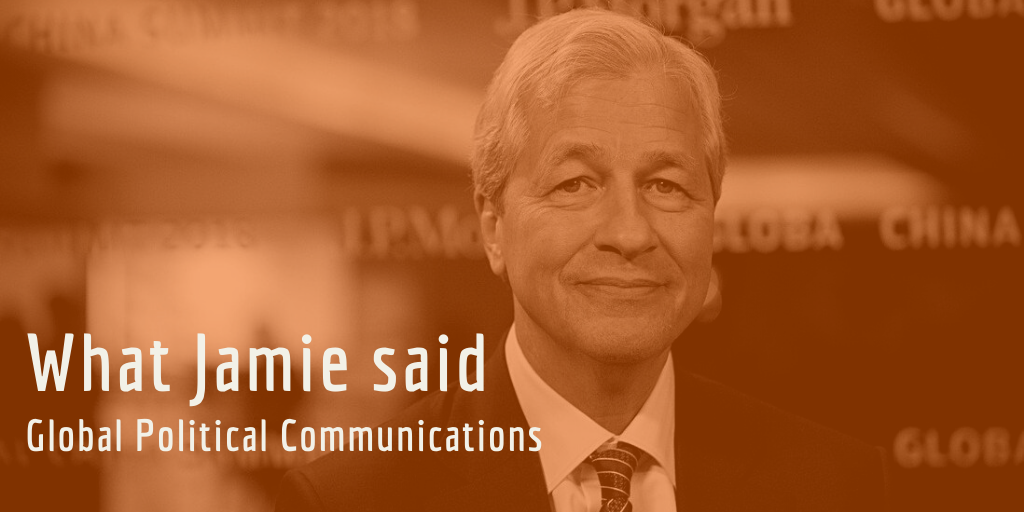
Last week at a Boston College Chief Executives Club event, JPMorgan Chase & Co. CEO Jamie Dimon relayed a "joke" he made during his recent visit to Hong Kong:
"The Communist Party is celebrating its 100th year. So is JPMorgan. And I'll make you a bet we last longer."
This "joke" was not well received in Beijing.
Actually, we don't know how the "joke" was received in Beijing.
The crackerjack communications team at JPMorgan Chase moved lightning quick to dampen any damage to relations with the country.
China is a market JPMorgan has spent decades and massive dollars on economic diplomacy to secure the necessary market access blessings and licenses to take advantage of China's growing prosperity and sophisticated banking needs.
I have never met Dimon, but he strikes me as someone who spent his college preps years strumming in a garage band.
He certainly has moxie.
There was speculation that Dimon would serve in the Obama Administration as Secretary of the Treasury, and he spent much of 2019 mulling a 2020 presidential run - correctly, he decided that he couldn't win either party's nomination.
He certainly has moxie.
So it shouldn't surprise anyone that Dimon would make a "joke" that JPMorgan will last longer than the Chinese Communist Party.
Here are the four lessons from this "joke":
One: When dealing with the Chinese Communist Party, short of praise and sun-god worship, nearly anything you say about China will not be well received by some faction of or all of the Chinese Communist Party.
Team Xi has fomented a toxic stew of victimhood and hyper-masculinity to carve out a slice of global respect.
Plus, global business reporters are happy to play gotcha reporting knowing full well that Beijing will negatively respond to any comments weakening its legitimacy.
China being cross is an evergreen analysis these days.
Knowing this communications reality coupled with having confidence that you are speaking respectively and without malice is a necessary starting point.
Two: Dimon is right to make this bet. JPMorgan has been operating in China since 1921, the same year the Communist Party was founded there.
But the bank has over one hundred more years of experience than the party as it traces its roots to 1799 in New York City. Plus, the company is a collection of more than 1,200 predecessor institutions that have come together through the years to form today's company.
There is no doubt a private company can move and shift more quickly than a political party operating as a national government.
The Lindy Effect, the idea that the older something is, the longer it's likely to be around in the future, alone suggests JPMorgan will last longer.
Three: Even if Dimon was honestly "joking," multinational CEOs have had enough of kowtowing to China's endless demands for praise and respect in light of growing wolf warrior petulance and increased human rights violations.
Just as we have seen from Women's Tennis Association Chairman and CEO Steve Simon's relentless campaign to protect one of its stars, business leaders will more and more say what is actually on their mind what it comes to China.
As Bloomberg reports: "A confluence of factors—heightened US-China tensions, intensifying repression within China, and, most of all, more pressure on companies outside China to support social equity—will make it harder and harder for big business to turn a blind eye to Beijing's abuses. The outcome could be a lot more sharp confrontations between prominent businesses and the Chinese state, with the potential to reshape China's economic relationship with the rest of the world."
Four: If you need to walk back your China statement, do it like Dimon.
As the Financial Times reported, Dimon issued a statement: "I regret and should not have made that comment. I was trying to emphasize the strength and longevity of our company."
Hours later, he apologized again. "I regret my recent comment because it's never right to joke about or denigrate any group of people, whether it's a country, its leadership, or any part of a society and culture. Speaking in that way can take away from constructive and thoughtful dialogue in society, which is needed now more than ever."
Words matter.
Note that Dimon never apologizes to China.
Plus, he never used the famous Chinese Communist Party talking point of "hurting the feelings of the Chinese people."
Finally, he didn't reaffirm support for China's territorial integrity or praise the party.
He said just enough to make the point and send a subtle message to Beijing that words matter.
As professionals on both sides of the Pacific know, JPMorgan won approval from Chinese regulators earlier this year to fully own its China securities venture -- a sign that US financial firms are forging ahead with plans to expand in the country despite tensions between the world's two largest economies.
Global high-level business is no joke; even Beijing and Team Xi understand that.