Your risk matrix needs an update

One war, five company emergencies, and escalating geopolitical risks demand immediate attention from your leadership.

The 82nd Airborne Division is deploying to the Middle East. The Strait of Hormuz is closed. Taiwan is rationing LNG. Chevron is warning California of a fuel crisis. And in America, TSA agents are working without pay.

Meanwhile, a New Mexico jury just handed Meta a $375 million verdict for what its leadership knew about harm to children and chose not to address. And Beijing published a Communist Party masterplan for technological dominance through 2030.

These stories are interconnected, forming a single, urgent narrative that directly involves your organization and its strategic choices.

The pattern is clear: geopolitical risk is disrupting your supply chain now, with issues in Taiwan, California, and beyond affecting your operations.

Consider the chain of exposure. Taiwan sources more than a third of its LNG from Qatar. Qatar ships through the Strait. The Strait is closed. Taiwan's semiconductor fabs — the ones your supply chain depends on for chips, components, and finished goods — run on power supplied by that gas. Airgas is already curtailing helium orders. Australia is reporting fuel shortages at hundreds of service stations. Chevron is issuing warnings. These are not warning signals. They're already happening and are directly connected to the same conflict your board may still be treating as background noise.

The DHS shutdown adds another layer. Delta suspended its special airport services for members of Congress because TSA agents aren't being paid. The people who screen your executives and cargo are working without compensation. That is not a political story. It is a logistics variable — one that compounds unpredictably the longer it continues.

The Meta verdict deserves a careful read from every general counsel in your organization. The jury did not simply punish Meta for what it did. It punished Meta for what it knew, when it knew it, and what it chose not to disclose. Any executive who believes that internal awareness of risk — unaccompanied by public disclosure — insulates the company from liability should reassess that assumption before the next board meeting.

And then there is Beijing. The Communist Party's 2030 tech masterplan is not a policy document. It is a competitive strategy. Systematic in scope. Specific in execution. If your business competes in artificial intelligence, semiconductors, clean energy, or advanced manufacturing, this is not a document to track in a quarterly risk report. This document will help you build your competitive response now.

Three things your company should do before this week ends:

1. Map your Hormuz exposure — specifically, not theoretically. Which suppliers, raw materials, and energy inputs flow through the Persian Gulf? What is your contingency sourcing plan? If the answer is incomplete, that is the gap to close.

2. Update your legal posture on what your organization knows. The Meta verdict extends the liability calculus well beyond social media. Platform operators, consumer products companies, and healthcare technology firms — all of them face a more aggressive litigation environment on the question of internal knowledge versus public disclosure.

3. Treat Beijing's 2030 plan as a planning input, not a news item. Model your competitive positioning against it. The companies that read it as background noise will have a harder time explaining their unpreparedness to boards two years from now.

The executives who successfully navigate this environment are the ones who stopped treating geopolitics as a separate department and began treating it as a core strategy. That's what Caracal Global does. Fractional Chief Geopolitical Officer services for Fortune 1,000 companies and private equity portfolio companies — Intelligence, Strategy, and Communications, without the overhead of a full-time hire.

If today's briefing confirmed that geopolitical risk is on your company's agenda and you don't have a geopolitical officer in the room, that is the conversation we should be having. Email me @ marc@caracal.global and let's get to work.

Enjoy the ride + plan accordingly.

-Marc

*****

Marc A. Ross is a geopolitical strategist and the founder of Caracal Global, a fractional Chief Geopolitical Officer service for Fortune 1,000 companies and private equity firms. He publishes the Caracal Global Daily — what a Chief Geopolitical Officer monitors every morning. Subscribe at caracal.global/contact.
Someone knew

+ Half a billion dollars. Twenty-seven seconds. And your company was the last to know

At 6:49 am New York time on Monday, roughly 6,200 oil futures contracts changed hands in the span of sixty seconds. The notional value: $580 million, according to Financial Times calculations based on Bloomberg data. S&P 500 futures surged moments later. Trading volumes spiked across global energy markets.

Twenty-seven seconds before 6:50 am, to be precise.

At 7:04 am, President Trump posted on Truth Social that there had been "productive conversations" with Tehran. Markets moved by $1.7 trillion in minutes. Oil sank. Energy stocks dropped.

Then Iran's parliament speaker logged onto X and called it fake news used to manipulate financial and oil markets.

Set aside, for a moment, the geopolitical question of who is telling the truth.

Here is the business question: someone placed a half-billion-dollar bet on the direction of oil markets 27 seconds before a presidential social media post moved global asset prices by nearly $2 trillion.

That is not an anomaly. That is your operating environment.

The pattern is the point

The sequence is now familiar. Escalation. Signal of a deal. Counterparty denial. Market recovery. Repeat. It played out on tariffs. It played out in Ukraine. It is playing out now in Iran.

Each cycle conditions markets to treat the next signal as incrementally less credible. Each cycle also creates a window, measured in minutes, where someone with better information than your board makes an asymmetric bet.

This is not a news cycle to monitor. It is a structural condition that can be managed.

The IEA's executive director told the New York Times that the war in Iran represents a larger energy disruption than the two 1970s oil shocks combined. United Airlines is modeling $175 oil through 2027. Chevron's chief executive says markets have not fully priced in a closure of the Strait of Hormuz. Slovenia is rationing fuel. Chinese drivers are queuing at petrol stations. Japan is drawing on strategic reserves.

The signal your board is receiving right now is: Trump says talks are happening; Iran says they are not; markets swung 3 percent; and we are monitoring the situation. Monitoring the situation is not a geopolitical strategy.

3 things the Iran cycle confirms

1. Energy price volatility is structural, not transitional. It is the baseline operating assumption through at least 2027. United Airlines has modeled it into planning. Chevron has said publicly that even reopening the strait will not quickly resolve supply disruption. Companies still treating this as a transient shock are mispricing their own exposure.

2. The US-Iran negotiating gap is wider than markets have priced. Iran's parliament speaker does not go on X to loudly deny diplomatic contacts unless he intends to send a signal. That is not a communication error. It is a deliberate message to Washington, to markets, and to Tehran's domestic audience. The deal that markets briefly traded on Monday morning does not exist yet.

3. The EU-US relationship is under more structural pressure than at any point since the Cold War. European governments will not trade support for Ukraine for Middle East cooperation. NATO coordination, transatlantic trade architecture, and regulatory alignment are all operating on a shakier foundation than the consensus view assumes. For companies with material exposure on both continents, that is a business risk, not a political observation.

A fractional Chief Geopolitical Officer

Tariff volatility. NATO credibility erosion. Supply chain disruption. Chinese competition. Accelerated warfare. AI and tech sovereignty. Export control tightening. Interest rate uncertainty.

These aren't background noise. They're reshaping your capital allocation, supply chain strategy, and competitive positioning — right now.

Your competitors are responding strategically. Are you responding reactively?

A Chief Geopolitical Officer doesn't wait for breaking news. They monitor geopolitical signals daily, translate them into business implications, and prepare board members and senior executives to decide — not scramble.

Most Fortune 1,000 companies and private equity portfolio companies don't have one. Caracal Global is your fractional Chief Geopolitical Officer.

Caracal Global provides fractional Chief Geopolitical Officer services for Fortune 1000 companies and private equity portfolio firms. Intelligence + Strategy + Communications, without the overhead of a full-time hire.

If Iran, Hormuz, or China is now on your board's agenda and you don't have a geopolitical officer in the room, that is the conversation we should be having. Email me at marc@caracal.global and let's get to work.

Enjoy the ride + plan accordingly.

-Marc

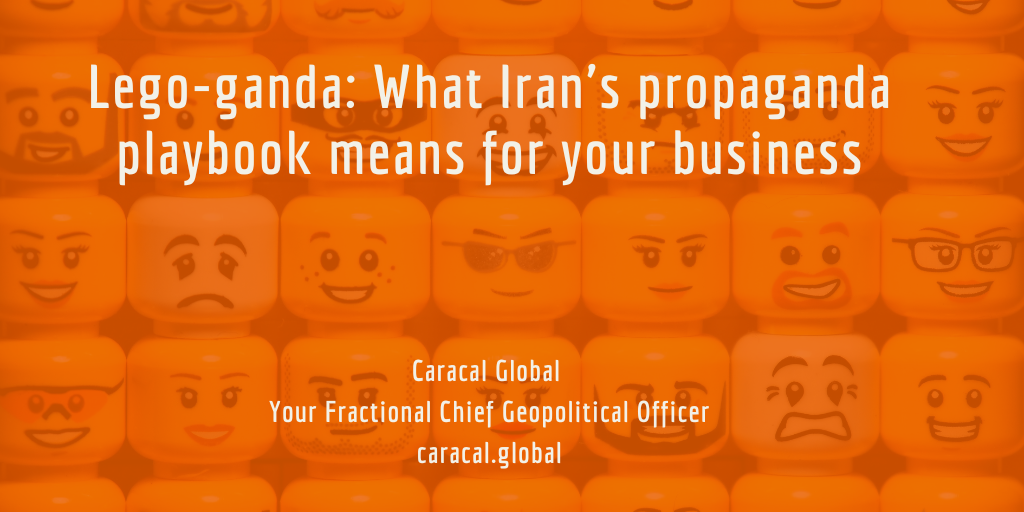
Lego-ganda: What Iran's propaganda playbook means for your business

State-sponsored propaganda has moved far beyond government-to-government signaling. It's now in your employees' news feeds, your customers' social media, and your stakeholders' sense of reality.

Lego made $13 billion last year. It also became an Iranian propaganda vehicle.

That's the headline from a recent Wall Street Journal investigation into the new information wars. Iran has been producing slick AI-enhanced videos using Lego animations, Japanese anime aesthetics, and Pixar-style visuals to sanitize combat footage, celebrate military strikes, and reframe its narrative for global audiences. The cartoonish format bypasses social media content filters. It travels freely. And it works precisely because Lego carries what Lukasz Olejnik, an independent technology consultant and a visiting fellow at the Department of War Studies, King's College London, calls "reloaded emotional associations" that bypass critical thinking.

The Trump administration is running its own playbook. Wii graphics. Call of Duty overlays. Top Gun clips. AC/DC soundtracks. Real airstrike footage spliced with Iron Man. The goal: lock in the emotional framing before the domestic audience and American voter registers what they're actually watching.

Olejnik puts it plainly: "There's no going back. Trolling is now a standard tool of statecraft."

None of this is happening in a vacuum. And none of it is happening somewhere else.

It is happening within the information environment that your leadership team, workforce, customers, and board members consume every single day.

Why is this type of communication a business problem?

Most executives still treat information warfare as something that happens between governments, on cable news, in some distant theater of conflict. That framing is dangerously outdated.

State-sponsored propaganda has moved far beyond government-to-government signaling. It's now inside your employees' news feeds, your customers' social media, and your stakeholders' sense of reality. And increasingly, consumer brands are not just bystanders—They're the vehicle.

Lego didn't consent to becoming a propaganda asset. It didn't matter. The brand's global recognition and emotional resonance made it useful. That same logic applies to every trusted company, industry association, or executive voice that state actors can leverage, mimic, or discredit.

Consider what this means for your corporate communications strategy. The assumptions underpinning it — that credibility is built over time, that facts compete fairly with disinformation, that your messaging reaches your audience in an uncontested information space — are no longer reliable.

Your communications infrastructure was built for a different era. So was your risk function.

The convergence that changed everything

Two forces collided to produce this moment. AI slashed the cost of producing high-quality propaganda to near zero. And over decades of globalization, trusted Western cultural touchstones — Lego, Pixar, Nintendo, Marvel — were exported into every major market on Earth.

The result: state actors now have access to a global cultural toolkit with built-in emotional resonance, production tools that require no studio or budget, and distribution platforms that struggle to distinguish authentic content from state-sponsored manipulation.

The Wall Street Journal piece notes that this content isn't aimed solely at domestic audiences. It travels. It reaches allied nations, neutral countries, and, yes, the offices of Fortune 1000 companies that are trying to make sourcing decisions, navigate export controls, and assess geopolitical risk in real time.

Your intelligence inputs are contaminated. If your team is concluding open-source news, social media, or unvetted digital content without a rigorous analytical framework, they are almost certainly working from a compromised picture.

What business leaders need to do

1. Audit your intelligence inputs. Where is your leadership team getting its information? Is it from primary sources, institutional media with verified editorial standards, or open feeds that are actively being manipulated? Information diet matters. Build a sourcing protocol that distinguishes signal from noise, and from weaponized noise.

2. Brief your board on information warfare. Directors are processing the same contaminated information environment as everyone else. They need to understand how AI-generated propaganda operates, what it looks like, and why it's structurally designed to bypass skepticism. A prepared board makes better decisions under pressure.

3. Protect your brand from weaponization. Review your brand's global footprint and cultural associations. What makes your brand trusted and recognizable also makes it potentially useful to bad actors who want to borrow that credibility. Work with your legal, communications, and government affairs teams to build early-warning protocols.

4. Recalibrate your corporate communications strategy. Clarity, consistency, and verified sourcing now function as competitive advantages in an environment where audiences are bombarded with emotionally engineered content. Executive communication that is sober, specific, and credible carries premium weight. Complexity is not your enemy. Vagueness is.

5. Build direct government intelligence relationships. Corporate intelligence functions that rely purely on open-source and commercial data are operating at a structural disadvantage. The most sophisticated companies are building formal channels with government stakeholders — not to lobby, but to share and receive timely, vetted threat intelligence.

The strategic frame

Tariff volatility. NATO credibility erosion. Supply chain disruption. Chinese competition. Accelerated warfare. AI and tech sovereignty. Export control tightening. Interest rate uncertainty.

Weaponization of propaganda is not a separate threat. It is the environment in which all of these other risks are communicated, processed, and responded to. You cannot make sharp decisions in a blurred information landscape.

The executives who navigate this period effectively will not be the ones who consumed the most information. They'll be the ones who have disciplined frameworks for evaluating it.

So, Lego-ganda, are you responding reactively?

A Chief Geopolitical Officer doesn't wait for breaking news. They monitor geopolitical signals daily, translate them into business implications, and prepare board members and senior executives to decide — not scramble.

Most Fortune 1,000 companies and private equity portfolio companies don't have one. Caracal Global is your fractional Chief Geopolitical Officer.

Enjoy the ride + plan accordingly.

-Marc

*****

Marc A. Ross is a geopolitical strategist and the founder of Caracal Global, a fractional Chief Geopolitical Officer service for Fortune 1,000 companies and private equity firms. He publishes the Caracal Global Daily — what a Chief Geopolitical Officer monitors every morning. Subscribe at caracal.global/contact.