10 years, 7 PMs, and the lesson nobody in Britain learned

Tuesday marks ten years since Britain voted to leave the European Union. As the anniversary arrives, Keir Starmer has resigned, clearing the path for the country's seventh prime minister in a decade. David Cameron, Theresa May, Boris Johnson, Liz Truss, Rishi Sunak, Starmer, and now a seventh, with former Greater Manchester mayor Andy Burnham the runaway favorite to take the keys to Number 10.

Seven leaders in ten years.

For context, Margaret Thatcher and Tony Blair each ran the country for more than a decade on their own. Britain has now churned through prime ministers at roughly one every 18 months since it decided to redraw its relationship with the rest of the world.

I have written about Brexit many times over the years, and I want to be careful here.

The point of this Ross Rant is not to relitigate whether leaving was right or wrong (it was wrong). Reasonable people disagree, and the economic arguments cut in more than one direction depending on which figures you trust. The point is narrower and more useful to you: Brexit is the clearest case study of the last decade in what happens to a society, a culture, and a business environment when leadership treats a major inflection point as a moment to be explained rather than a moment to be communicated.

Here is the distinction that matters.

An explanation comes after the decision. Communication comes before, during, and after. The Leave campaign understood this. "Take back control" was three words that did the work of a thousand white papers. It told a story about agency, identity, and a future. The Remain campaign responded with GDP forecasts and warnings from economists. One side communicated. The other side explained. We know how that ended.

What followed was a decade of leaders who kept making the same mistake in the other direction. They won or inherited power, then governed as if the job was to manage the file rather than to keep telling the story. May tried to explain a withdrawal agreement nobody could follow. Truss tried to explain a fiscal plan that the bond market rejected within two days. Sunak tried to explain competence to a public that had stopped listening. Starmer, less than two years after a landslide, tried to explain why the change he promised kept getting watered down or scrapped. Each one treated communication as the thing you do after you decide. Each one was gone before the next anniversary.

Three things this means for leaders facing a major inflection point of their own:

First, at an inflection point, the story moves faster than the strategy. The Leave side won because it had a narrative before it had a plan. That is uncomfortable for operators who believe the work should speak for itself. It does not. In a moment of upheaval, the audience immediately reaches for meaning and will accept the first coherent story on offer. If you are still assembling your facts while someone else is offering meaning, you have already lost the room. Have the story ready before the decision lands.

Second, upheaval does not end when the decision is made. It begins there. Britain treated the 2016 referendum as a finish line. It was a starting gun. Ten years and seven prime ministers later, the country is still arguing about what the vote meant and still postponing summits to reset the relationship it thought it had settled. When your company makes a major move, a merger, a restructuring, or a market exit, the communications work is not the press release. It is eighteen months later, when employees, customers, regulators, and investors are each writing their own version of what happened. If you go quiet after the announcement, they will write it for you.

Third, the cost of a communications vacuum is paid in trust, and trust does not return on the same schedule it left. The deeper story of British politics this decade is not any single leader's failure. It is the steady erosion of public belief that anyone in charge can actually change anything. As the Liberal Democrat leader put it on Monday, the public is tired of changing who sits in Number 10 while nothing else changes. That is what a decade of explanation, rather than communication, produces. A population that has stopped believing the words. Your stakeholders are no different. Spend the trust carelessly at one inflection point, and you will not have it at the next one.

The world has changed. The way you need to explain it has not. Most leaders still treat communications as a tactic for explaining decisions after they are made. Brexit is a ten-year monument to the cost of that instinct, played out at the scale of a nation. The leaders who win in this environment treat communication as a strategy that shapes how an audience understands a decision before it is made, as it unfolds, and long after the announcement. Not an explanation bolted on at the end, but the strategy that carries the whole thing.

Britain has had ten years and seven prime ministers to learn that lesson. Your next inflection point will not give you nearly that long.

Enjoy the ride + Plan accordingly.

-Marc

The Sporting Caracal Global | June 20, 2026

The Sporting Caracal Global

June 20, 2026 

Sport at the intersection of geopolitics, commerce, and governments. With insights for better communications from an athletic perspective, and a Knicks parade where two million showed up.

The Knicks won the NBA championship, and New York gave them a ticker-tape parade that the NYPD estimates drew two million people, the largest planned-event security deployment in city history. The same week, the World Cup is being played in eleven NFL stadiums across the country, and a man on the street in a host city wrote that "hardly anyone seems to care." Two American sporting spectacles, one homegrown and overflowing, one imported and oddly muted. That contrast is the lens this week.

Five stories where the score matters less than who controls the story, plus the Person and Athlete of the Week.

The lead: The biggest event on earth is the quietest one in America

The story of the week in sport is not a result. It is the silence around a tournament that nearly half the planet is watching.

The US won its opening match convincingly, with nearly 25 million viewers across Fox, Telemundo, and Peacock. And yet the dominant sound from inside the host country is a shrug. Fox, which paid for the English-language rights, spent the week publicly frustrated that ESPN was covering the event only marginally. A fan in a host city wrote that it feels nothing like 1994, that the NBA Finals are pulling more attention than the biggest sporting event on the planet. The Knicks parade drew two million people. The World Cup is drawing complaints about who is not promoting it.

Readers of this memo have followed this thread since the May 9 launch: the empty hotel rooms, the pricing collapse, the entry denials, and now the strangest chapter yet, a home World Cup the home country is not emotionally attending. The tournament was sold as a soft-power triumph. What it is producing is a case study in the difference between hosting an event and owning it.

The communications principle holds: presence is not the same as enthusiasm, and you cannot manufacture the second by securing the first. FIFA and the US delivered the stadiums, the matches, and the broadcast windows. None of that generates the feeling that 1994 had, because feeling is not a logistics problem. The most valuable global moment of the decade is being staged in a country that has not decided it cares, and no amount of rights money fixes a missing emotion.

+ More World Cup players were born in Montevideo than in any other city on earth. 142, all-time. A country that has never had more than four million people, ahead of Mexico City, ahead of Buenos Aires. Uruguay is football's strangest outlier, and a reminder that concentration of excellence rarely correlates with size.

Messi's missing whistle, again

Roy Keane spent the week arguing that a late, studs-up Messi challenge that went unpunished proved the rules bend for the game's biggest names. The same debate ran the week before, when Messi's hat-trick dominated coverage and a similar tackle went unpunished. The pattern is the story now.

This is a governance-communications parable, and it applies far beyond football. When an institution visibly applies its own rules differently to its stars, it loses credibility that it cannot easily regain. Every player sent off for less is now evidence. Every fan who saw the no-call is now a witness. FIFA's product depends on the belief that the laws of the game mean the same thing for everyone, and each protected superstar erodes that belief a little more, in full view of four billion people. The durable principle: selective enforcement is a communications decision, whether you intend it or not, and the audience always notices who gets protected. Institutions that bend the rules for their most valuable players are mortgaging the one asset, perceived fairness, that makes the players valuable in the first place.

The White House invitation is a position, not a photo op

Knicks owner James Dolan announced on WFAN that the White House has invited the championship team, and the Knicks have accepted. Vanity Fair reported the administration insists no team has ever declined, while noting that no championship-winning NBA team has visited this White House. The visit is now a story before it has happened.

This is the lesson every federation, franchise, and sponsor keeps relearning: in this environment, the ceremonial has become political, and there is no neutral option. Accept the invitation, and you have taken a position. Decline it, and you have taken a position. Say nothing, and the silence is read as a position. The Knicks just walked into the exact minefield the US men's national team has been navigating all tournament, where every player's answer to a White House question becomes a headline, regardless of the answer.

The discipline is to decide your posture before the camera arrives. The teams and brands that handle this well are the ones whose answer was settled in a quiet room weeks earlier, calm and consistent, and theirs. The ones who improvise on the South Lawn discover that improvisation is the worst available strategy when every option is already loaded.

A documentary before the dynasty

Ben Stiller confirmed on Jalen Brunson and Josh Hart's podcast that he is making a multi-part Knicks documentary with A24 and HBO, charting the franchise's first championship in 53 years. The deal was announced inside the celebration, before the confetti was swept up.

The lesson is about owning your story while you still control it. The Knicks won, and within days the definitive telling of that win is being produced by people the franchise and its players chose, on a platform they selected, in a format they shaped. Compare that with the organizations that wait, lose control of the narrative to whoever shows up first, and then spend years trying to correct a story someone else authored. The most valuable moment to decide how your triumph gets told is the moment of the triumph, when the audience is largest, and the meaning is still yours to set. Stiller is not making this film in five years. He is making it now, because now is when the story is worth the most and least contested.

Skechers' sequel: Caitlin Clark and the second move

Nike unveiled the Caitlin 1, which releases on October 1 for $140. A week after OG Anunoby's Skechers moment ran through the NBA Finals, the reminder here is that the incumbent still owns the most valuable positioning real estate in basketball when it moves early and commits.

The communications lesson is about sequencing, not spending. Nike did not chase Clark after she became a phenomenon; it positioned around her on the way up and is now releasing the signature product at the peak of demand. That is the same play Skechers ran with Anunoby from the challenger side: take the position before the moment, then let the moment arrive. The contrast worth holding is that both the incumbent and the insurgent win the same way, by being early, and both lose the same way, by trying to buy in after the peak. Caitlin Clark at $140 a pair is what it looks like when the biggest brand in the category remembers that credibility compounds from early positioning, not late checkbooks.

Person of the Week: James Dolan

The Knicks owner spent the championship run telling his players to abstain from sex before the final, then surfaced this week to announce the White House visit on sports radio and watch two million people fill Broadway for his team. As a communications figure, Dolan is a study in how winning launders almost everything.

The abstinence advice was mocked; the science does not support it, and in any other season it would be the story. Instead, it is a footnote, because the Knicks won, and victory is the most powerful message-cleaner in sport. That is the cautionary half of the lesson: winning buys forgiveness for communications missteps that would sink a losing operation, which is precisely why owners and executives mistake the forgiveness for endorsement. Dolan did not get good at communicating this year. His team got good at basketball, and basketball covered for the communication. The leaders who confuse the two are the ones who keep talking the same way after the winning stops, and discover the room was never actually agreeing with them. For now, Dolan has a parade, a documentary, and an invitation. The communications bill, as always, comes due in the first season the team does not win.

Athlete of the Week: Josimar "Vozinha" Dias

The Cape Verde goalkeeper carried his small island nation, with a population under half a million, into the World Cup, and last week, US officials had to intervene so that his mother could attend, because she could not afford the $15,000 bond required for a visa from Cape Verde. He kept the run alive on the field and a human story alive off it, and he did neither by talking.

This memo usually finds the communication stakes, and Vozinha's are quiet ones: he lets the achievement speak and lets others tell the story around it. A 40-something keeper from a nation that had never been to a World Cup does not need a media strategy. He needs to keep the ball out of the net and let the improbability do the rest, and the improbability did, drawing the kind of attention no campaign could buy and no bond requirement could blunt. Some weeks, the lesson is simply that the most powerful narrative is an earned one, and the most credible spokesperson is the result itself. Cape Verde may not advance. Vozinha has already won the only thing that lasts, a story that the whole tournament had to stop and notice.

Enjoy the ride + plan accordingly.

— Marc

Marc A. Ross | Chief Communications Strategist @ Caracal Global | The Sporting Caracal Global is published on Saturdays.

Caracal Global helps leaders understand the world and how to talk about it. The Sporting Caracal Global is a weekly memo applying the Caracal Global lens to sport: globalization, soft power, governments, and commerce, resolved on the communications stakes that decide who wins on and off the pitch.  Washington DC | Detroit | London  | caracal.global | marc@caracal.global

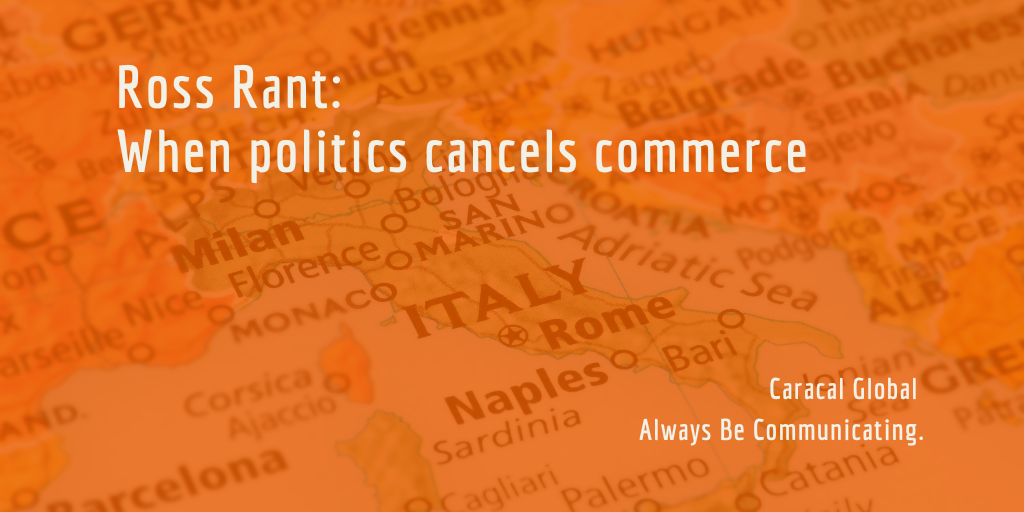
When politics cancels commerce

I was supposed to be in Miami on June 22.

The Italy–US Business, Investment, Science and Innovation Forum. Secretary of State Marco Rubio and Italian Foreign Minister Antonio Tajani opened the day, with dozens of Italian companies flying in, a B2B floor built for exactly the kind of deals this relationship is supposed to produce. Months of organizing. An Embassy science track. A cultural exhibition flown in from Italy.

Canceled. Days out.

The Forum didn't fall apart because the business case was weak. The companies were ready. The investment thesis was sound. The science was real.

It fell apart because Italy drew a line.

After President Trump publicly mocked Prime Minister Meloni, Foreign Minister Tajani called the remarks "grave and offensive" and canceled his US visit. His visit was the reason the entire Forum was built around. "Neither I nor Italy ever beg," Meloni said. This was not a scheduling conflict. It was a sovereign country deciding that dignity is a precondition for partnership, and that it would forgo a marquee economic event rather than be treated as a supplicant.

Sit with what that means for business.

One of America's most reliable European allies, led by a prime minister who was the only major European leader at Trump's second inauguration, chose to pull the plug on a months-in-the-making commercial forum over how it was spoken to. When respect erodes at the top, the commerce underneath it doesn't get a vote. The manufacturer who booked the flight, the founder who cleared the calendar, the trade office that spent six months building the room — all of it moves the moment the political relationship does.

This is the world in which business now operates. On both sides of the Atlantic, politics move fast, and they move first. A relationship that looks settled on Monday can be a diplomatic rupture by Friday. Political volatility is not background noise. It is the operating environment.

Three things for leaders to note:

1. Build political risk into commercial planning, not as what-ifs, but as a live variable that can erase an event, a deal, or a quarter on short notice.

2. Hold your relationships independent of the institutions that convene them. The Forum is postponed. The people I connected with through it are not going anywhere. That is the difference between depending on an event and building a network.

3. Communicate through the disruption, not around it. When the ground moves, silence reads as confusion. The leaders who come out ahead are the ones whose stakeholders never have to wonder where they stand.

The world you planned for is not always the world you have.

I still intend to be in that room when it reconvenes. The relationship between these two economies is bigger than any single date on a calendar — and the way to honor it is to insist, as Italy just did, that partnership runs both ways.

Enjoy the ride + Plan accordingly.

-Marc
*****

Marc A. Ross helps leaders understand the world and how to talk about it. Two decades at the intersection of commerce and government. He is the Founder of Caracal Global and Brigadoon. He works with leaders who cannot afford to be reactive in an environment defined by permanent disruption. DET, WAS, EDI, LON. marc@caracal.global | marc@brigadoon.live | +1 202 596 5270

*****