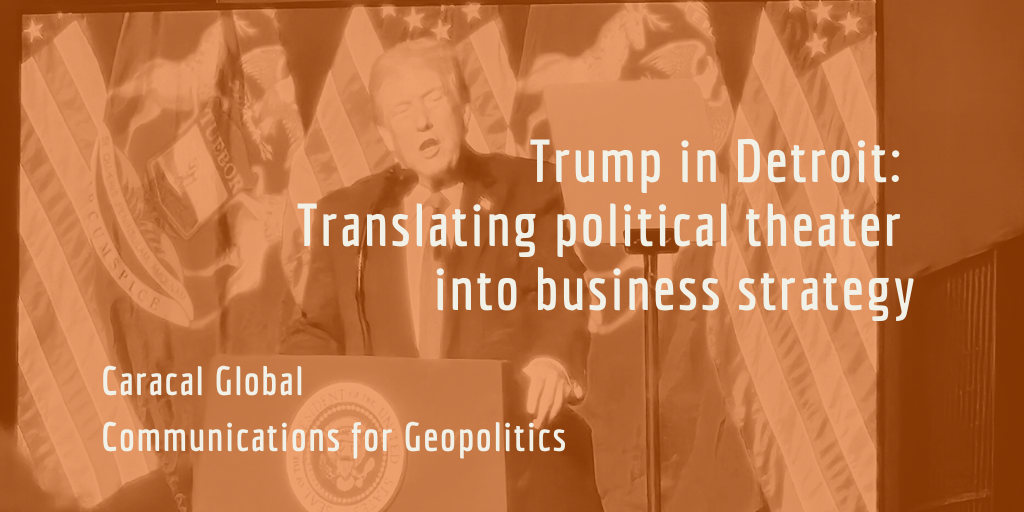
If you wanted a sense of how critical the Global Great Lakes region is to US politics heading into the 2026 and 2028 elections, President Trump's first campaign-style speech of the year in Detroit provided that answer.
Before addressing the Detroit Economic Club (DEC), Trump toured the Ford Rouge Complex – a manufacturing plant where both of my grandfathers worked. It's a political must-stop when visiting Detroit, and the symbolism wasn't lost on anyone.
I attended Trump's address to approximately 1,000 DEC members and guests – business and civic leaders, executives, Michigan elected officials, and the White House press corps. This marked Trump's third speech to the DEC, which continues serving as a premier platform for political leaders across the spectrum to test campaign themes.
What I observed from a strategic communications perspective:
This was decidedly not a policy speech, and it was a missed opportunity for Team Trump and House Republicans on the ballot this fall. Trump's speech was billed as about the economy, an issue on which the president has been struggling in the polls. But Trump veered from topic to topic, targeting transgender athletes and trashing old political rivals. Trump delivered what the audience expected: campaign rhetoric testing themes for his upcoming State of the Union speech and the 2026 midterm elections – from "landslide victory" messaging to attacks on "affordability" as a "fake word by Democrats." He went off-teleprompter frequently, mixing substantive economic discussion with political attacks.
The business takeaways:
The speech revealed key policy priorities that executives need to monitor:
+ Tariffs as economic doctrine: Trump called tariffs his "favorite word" and defended them as national security tools, dismissing cost concerns despite studies showing American firms bearing 94% of tariff costs.
+ Auto sector calculations: Tax breaks and rollbacks of EPA/CAFE standards signal continued prioritization of traditional manufacturing. However, he floated the idea of allowing Chinese automakers into the US market – a statement that drew notable silence.
+ Housing policy preview: Promised details at Davos next week, including potential bans on institutional investors buying single-family homes.
+ Healthcare and credit cards: Floated a 10% credit card interest cap with no implementation details, while simultaneously killing Biden-era consumer protections
The disconnect:
What struck me was the audience reaction. Policies that would energize rally crowds – attacks on Democrats and RINOs (Republicans in Name Only), transgender athletes, immigration enforcement – received muted response from this business audience. The applause came for fraud reduction and specific economic measures, not political red meat.
The bottom line for executives:
Manufacturing investments are being announced, but employment numbers tell a different story – Michigan auto manufacturing jobs are trending down since 2023, with 28,000 national auto jobs cut in the past year. The rhetoric about "the greatest economy" contrasts with grocery prices rising at the fastest pace since late 2022.
For multinational companies navigating US policy, the key insight isn't what was said – it's understanding how campaign-mode governance affects business planning horizons, regulatory certainty, and trade strategy.
Trump acts like a political day trader and does little to manage expectations for projects and policies that will take years, if not decades, to yield success and prosperity. Team Trump and House Republicans would be better served by managing expectations when speaking and identifying short-term, mid-term, and long-term policy goals and objectives.
At Caracal Global, we help business leaders decode exactly these moments – where political narratives intersect with commerce and policy. The gap between campaign messaging and business community priorities reveals strategic opportunities and risks.
More analysis coming on how these themes will shape the State of the Union and 2026 economic policy debates.
-Marc