
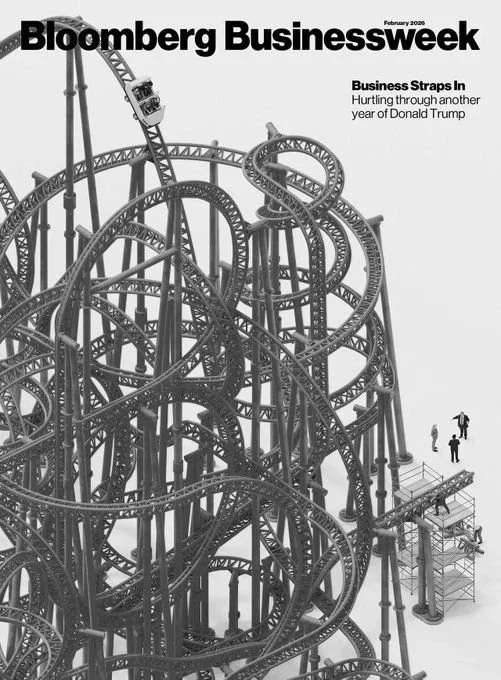
Looking at Bloomberg's stark cover image, a chaotic roller coaster representing the business's wild ride through another Trump presidency, this is a fundamental shift in how executives approach corporate-government relations.
This isn't business as usual. We're witnessing what historian Jonathan Levy of Sciences Po in Paris calls "unprecedented personalization of government and business dealings."
What I'm seeing on the ground
From my vantage point, advising Fortune 1000 companies and emerging tech leaders, I observe executives constantly recalibrating their strategies in real-time. The traditional playbook—the one that assumed institutional norms, policy predictability, and arms-length government-business relations—no longer applies. Trump has introduced what I call "patrimonial state capitalism," where loyalty to persona supersedes loyalty to laws and institutions.
Consider these moves in recent days: A proposed 10% cap on credit card interest rates that stunned Wall Street, pressure on energy companies to rebuild Venezuela's decrepit oil infrastructure, and a criminal investigation into the Fed Chair. These aren't isolated incidents. They represent a systematic rewriting of the rules of engagement between the Oval Office and corporate America.
The strategic framework I'm recommending
Drawing on my experience in presidential campaigns, energy regulatory environments, and emerging technology policy, I'm advising clients to adopt a multi-touch, expand the echo chamber communications strategy.
1. Strategic access isn't optional; it's essential: I'm helping clients build what Bloomberg calls "back channels," but I frame it differently: strategic stakeholder mapping. Access to Trump remains concentrated, but pathways exist through Chief of Staff Susie Wiles, Treasury Secretary Scott Bessent, and Commerce Secretary Howard Lutnick, both finance veterans who understand business language.
2. Education over confrontation: Bloomberg explored how Target CEO Brian Cornell's approach to dealing with the White House exemplifies what I advocate: lead with data, frame around presidential priorities, and use visual communication. Trump famously doesn't read briefing books, but he prides himself on his business instincts. I'm coaching executives to distill complex geopolitical and economic issues into compelling, visually supported narratives that align with Trump's stated goals: job creation, American manufacturing, and Main Street economics.
3. The medium shapes the message: Bloomberg wrote how Coca-Cola's James Quincey and Eli Lilly's Dave Ricks both chose Fox Business to announce major initiatives. This isn't coincidental, it's smart. I'm advising clients on media strategy optimization in an environment where conservative influencers and X form a coordinated amplification machine for administration messaging. Companies must understand that traditional media relations strategies don't capture the attention of this administration. I'm helping clients develop dual-track communication approaches, one for conventional stakeholders, another optimized for the MAGA media ecosystem.
4. Everything is indeed a transaction—but understand the currency: Bloomberg quotes BGR consultant David Urban, who cites a Beltway adage: “The first rule of horse trading is to have a horse.” This adage resonates with my experience in government relations. But here's what I'm seeing that goes beyond Bloomberg's analysis: the currency isn't just financial, it's political capital, media narrative, and symbolic gestures. Intel's handling of US government intervention, sponsorships of America's 250th anniversary celebration, and donations to the $400 million White House ballroom project represent strategic positioning investments. I'm helping clients evaluate which commitments provide genuine protection versus which create dependency without corresponding benefits.
The geopolitical business reality I'm tracking
Bloomberg's article focuses on domestic corporate strategy, but I'm advising clients on the international implications. Trump's interventionist approach doesn't stop at the US border; it reshapes global capital flows and supply chains, causes headaches in the capitols of allies and enemies alike, and alters the balance of power between business, regulators, and governments worldwide.
Critical observations from my work:
+ US-China commercial relations are being restructured through personalized diplomacy rather than institutional frameworks
+ Technology policy increasingly depends on individual corporate relationships with the administration rather than sectoral regulation
+ Trade policy has become a tool of political leverage rather than economic optimization
What I'm telling my clients right now
As I prepare executive briefings and intelligence memos, I emphasize five realities:
1. Scenario planning is your primary defense: I'm helping clients map out multiple futures—not just optimistic and pessimistic scenarios, but discontinuous possibilities. What happens if Trump's approval continues falling? How do midterm election outcomes shift the dynamic? What if monetary policy independence collapses? What if allies sell US bonds?
2. Communication strategy must be dynamic, not static: My "Always Be Communicating" philosophy takes on new urgency. Companies can't wait for crises to develop communication plans. I'm working with clients to establish real-time response protocols that allow rapid pivots as circumstances shift.
3. Your stakeholder map just got more complex: Traditional corporate advocacy through the Business Roundtable and Chamber of Commerce remains essential, but insufficient. I'm helping clients identify emerging power centers and build high-low relationships before they're needed.
4. Brand reputation + political positioning are now inseparable: The risk isn't just to share price—it's to corporate reputation with employees, customers, and investors who may have very different political orientations than the administration. I'm advising clients on triangulation strategies that maintain government relationships without alienating other critical stakeholders.
5. This isn't temporary—prepare for massive structural change: Whether Team Trump wins reelection or not, this personalized, interventionist approach to business-government relations has demonstrated its viability. I'm helping clients build capabilities and strategies that work in this environment while remaining adaptable to potential shifts.
The bottom line for global investors + executives
Bloomberg's assessment is accurate: We're dealing with the most interventionist US president in almost a century. But here's what I add from my geopolitical strategy perspective: this moment represents a fundamental test of corporate political intelligence and holistic communications.
The companies that thrive in this new paradigm won't be those with the best legal arguments or the most principled positions. They'll be organizations that combine strategic access, sophisticated communication, scenario planning, and genuine flexibility. They'll understand that in this new environment, relationships matter more than regulations, narratives matter more than norms, and adaptability matters more than ideology.
As Bloomberg notes, "A playbook only works when there are clear rules for the game, but Trump can change them at any time."
We're not on a predictable track. We're on that chaotic roller coaster Bloomberg depicted. But with the proper strategic framework, communication approach, and geopolitical awareness, companies can navigate this environment not just defensively, but in ways that position them for whatever comes next.
-Marc
Navigating the new corporate-Trump dynamic: A geopolitical business perspective
