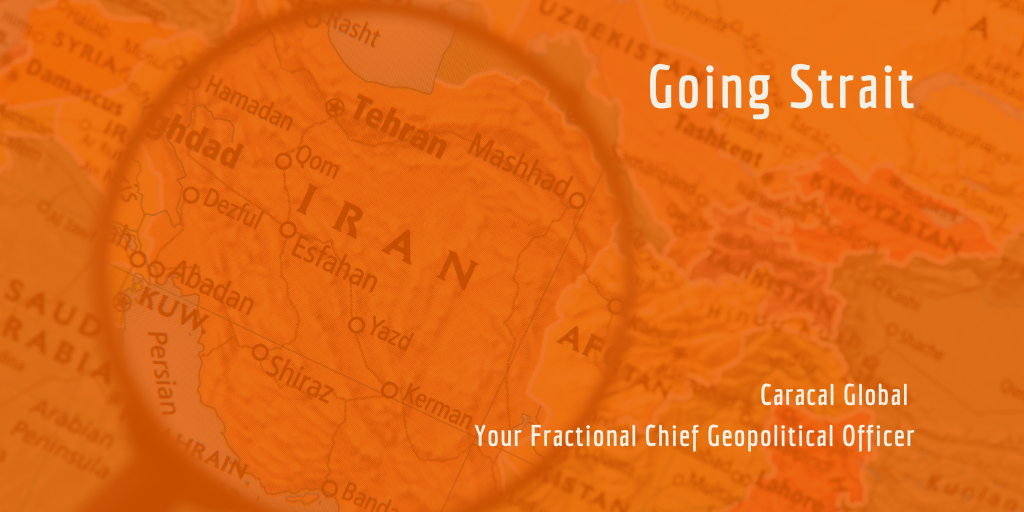
Three weeks ago, the Strait of Hormuz appeared in most corporate risk frameworks as a scenario — something flagged in annual reviews, noted in board presentations, and rarely acted upon. That era is over. Iran has demonstrated something that will outlast this conflict: closing the world's most critical shipping chokepoint is achievable, the United States cannot reopen it quickly or alone, and the economic consequences radiate far faster than any military response can contain them.
Drone strikes on Dubai's airport. Cyberattacks that knocked tens of thousands of Stryker employees offline. Satellite imagery of the Middle East is quietly disappearing from open-source intelligence feeds. Jet fuel prices are rising, and airlines are rerouting flights. An Emirates flight that departed Dublin, flew for ten hours, and turned back. This is not a regional conflict. It is a systemic stress test for the global economy — and most executive teams are still treating it like a headline rather than an operating reality.
The pattern this week is unmistakable. Trump bet that Iran would capitulate before closing the Strait. It didn't. US allies are declining the White House's call to send warships: Japan cites legal constraints, Britain says it won't be dragged into a wider war, Australia has declined, and Spain calls the conflict a threat to the global order. China — the country with the most genuine diplomatic leverage over Tehran — has no incentive to use it, particularly now that Trump is threatening to cancel the Xi summit as a pressure tactic. India is conducting quiet diplomacy and claiming results. Gulf states are recalculating their exposure. And Iran's drone and missile arsenal, cheap, plentiful, and battle-tested, is producing a conflict unlike anything the US military has faced in recent decades.
Three things your leadership team needs to act on now.
1. Energy cost assumptions for 2026 are wrong. Oil executives have already told the White House the fuel crunch will worsen. If your planning models reflect pre-war energy prices, rebuild them this week—Stress-test at $110, $120, and $130 per barrel. The Hormuz closure is not short-term noise. It has the structural characteristics of a prolonged disruption.
2. Semiconductor exposure is more immediate than most companies recognize. The war is threatening the helium and sulfur supplies that Taiwan's chipmaking sector depends on — and Taiwan Semiconductor alone accounts for roughly a fifth of Taiwan's economy. A sustained disruption cascades through consumer electronics, automotive, and industrial production, with limited lead time to respond. Procurement teams need contingency postures now, not in Q3 when the damage is already compounding.
3. Government affairs and corporate diplomacy are your most underutilized strategic assets in this environment. The countries navigating the crisis most effectively — India, Canada, the Nordics — are doing so through sustained diplomatic investment and active relationship capital. Your company needs the equivalent: direct access to decision-makers in the markets where you operate, intelligence on where policy is moving, and a communication strategy that positions your organization as a constructive actor rather than a reactive one.
Hormuz has demonstrated to every strategic adversary what is achievable at scale. The next disruption will come faster, from a different chokepoint, and with less warning.
This is precisely why Caracal Global exists. We specialize in global business issues at the intersection of globalization, disruption, and politics. We provide Fortune 1,000 companies and PE portfolio firms with fractional Chief Geopolitical Officer services — combining intelligence, strategy, and communications to help senior executives navigate today's interconnected business environment before a crisis becomes a cost. You need a CGO. You are not ready to hire one full-time. Caracal Global is your fractional solution.
Enjoy the ride + plan accordingly.
-Marc
*****
Marc A. Ross is a geopolitical strategist and the founder of Caracal Global, a fractional Chief Geopolitical Officer service for Fortune 1,000 companies and private equity firms. He publishes the Caracal Global Daily — what a Chief Geopolitical Officer monitors every morning. Subscribe at caracal.global/contact.