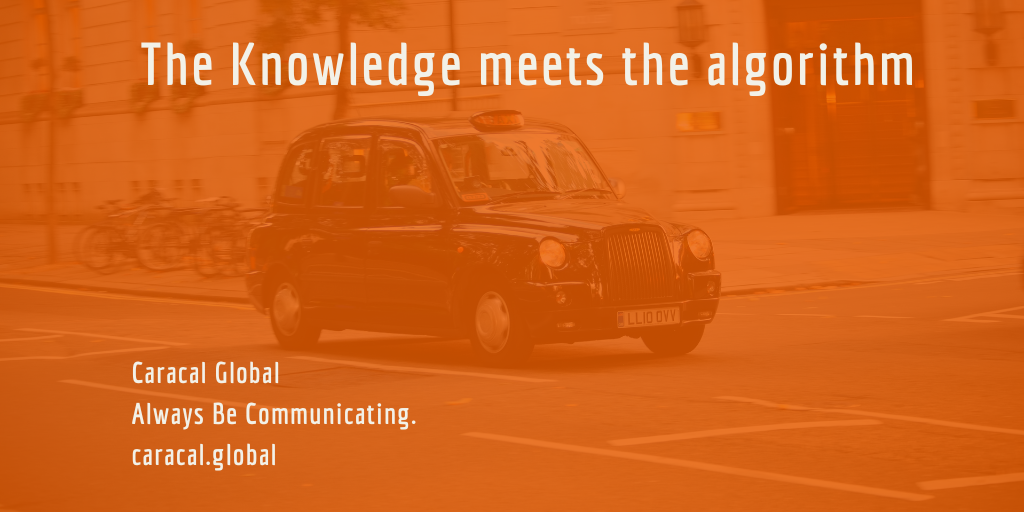
On May 17, 60 Minutes returned to a story I first wrote about back in 2019. The framing then was simple. Uber's mapping technology could not find my house in Old Town Alexandria, and London's cabbies, with their 161-year-old test called the Knowledge, were running circles around Silicon Valley.
Seven years later, the analog and digital sides of that fight are still in the ring, but the stakes have shifted. Waymo, owned by Alphabet, says it is now five times safer than a human driver and clocks more than two million miles per week across eleven US cities. Wayve, a British startup backed by Nvidia and Microsoft, is training its AI on London's roundabouts without first mapping the city. Both are racing to put robotaxis on London's streets later this year.
Meanwhile, London's licensed cab fleet has shrunk from 25,000 drivers a decade ago to 16,000 today. 60 Minutes followed cabbies as they worked to pass this grueling test. In the story, Steven Fairbrass has been studying for the Knowledge for eight years and just failed his 20th attempt. Anshu Moorjani finally passed on his 41st try after five years of trying. The exam still requires memorizing 25,000 streets and 6,000 points of interest. A University College London neuroscience study holds up after all this time. The posterior hippocampus, the brain's memory center, physically enlarges over the course of a cabbie's career.
So who wins?
That is the wrong question. The right question is who is communicating effectively, because the analog-digital fight in London is not really a technology story. It is a communications story, and both sides are losing it.
Three things this means for global executives operating in any category where deep tradition meets exponential technology:
The cabbies have a great story and no platform: The Knowledge is one of the world's most extraordinary professional credentials. It changes the brain's literal structure. It dates to 1865, when horse-drawn cabmen first sat for it. It requires roughly 50,000 miles of preparation on foot, by bicycle, and on a motor scooter before a candidate ever gets near a steering wheel. Tom Scullion, a 34-year veteran of the cabbie trade, put it wryly on camera. His Knowledge is to Google Maps what Gordon Ramsay is to a hot dog vendor.
That is great copy. It is also nowhere near the volume or reach of what Alphabet and Nvidia can put behind their case. The cabbies are speaking through individual interviews, union pickets, and word of mouth. Waymo is speaking through five-times-safer data points, polished co-CEO appearances on national television, and billions of dollars in marketing infrastructure. London's cabbies are functionally a heritage brand with terrible distribution. Heritage brands without distribution lose, regardless of product quality.
The robotaxi companies have great data and a credibility problem they refuse to address: Waymo's safety numbers are real. The sensor stack of 29 cameras, 6 radars, 5 microphones, and 5 lidar units is genuinely superhuman. The simulation training is impressive. None of that, however, is what shows up in the public record when a Waymo drives through an active police scene in Los Angeles, blocks emergency responders, or illegally passes a stopped school bus, leading to a software recall and a federal investigation.
The sector treats these incidents as edge cases and statistical noise. To regulators, mayors, transit unions, parents, and Transport for London, those incidents are the entire conversation. The communications failure here is not denial. It is tone. Waymo co-CEO Tekedra Mawakana, on camera, referring to Waymo as a driver with three lifetimes of experience per week, is technically accurate and emotionally tone-deaf. Voters and policymakers do not want a three-lifetime statistical entity making decisions about their streets. They want accountability with a name and a face. The robotaxi sector has not solved that problem, and pretending it does not exist is itself a strategic choice with consequences.
The regulators will resolve this fight, not the technologists: Transport for London has not yet approved driverless commercial pickup. Waymo and Wayve are testing under human supervision. Whichever side of this argument, analog or digital, captures the regulator's confidence first will set the terms for the next decade. That is a communications and stakeholder engagement contest. It is decided in select committee hearings, City Hall briefings, op-ed pages, transit safety boards, and the careful management of every single edge-case incident that makes the evening news.
The same pattern is playing out across every category where deep tradition meets exponential technology. Legal services. Medical diagnostics. Education. Manufacturing. Financial advisory. Aviation. In each case, the analog incumbents have brand equity, cultural standing, and stories of mastery that they fail to translate. In each one, the digital challengers have scale, data, and capital, but cannot speak the language of regulators, employees, and the affected public.
Seven years ago, I wrote that Uber could not find my house. The mapping has gotten better. The communications challenge has gotten harder. The Knowledge, in 2026, is no longer just about memorizing streets. It is about knowing who you need to convince, and in what order.
Enjoy the ride + plan accordingly.
-Marc.
You can always reach me @ marc@caracal.global
*****
Caracal Global is your communications partner for global business, at the intersection of commerce and governments. We monitor geopolitical signals daily: tariff announcements, military movements, policy shifts, trade negotiations, export control changes, and competitive positioning. We translate those signals into messages that your boards, investors, employees, customers, regulators, and the broader public understand.
Geopolitics + Communications. Intelligence, Strategy, and Communications for Fortune 1,000 companies, private equity portfolio firms, and founder-led businesses operating in an environment of permanent disruption. Detroit-born, with deep roots in the Global Great Lakes region. Active in Washington, DC, and London.
Most companies treat communications as the function that explains decisions after they are made. We treat it as the function that shapes how decisions are understood, before, during, and after.
Caracal Global is your Chief Communications Strategist.
Always Be Communicating.
Learn more at caracal.global.