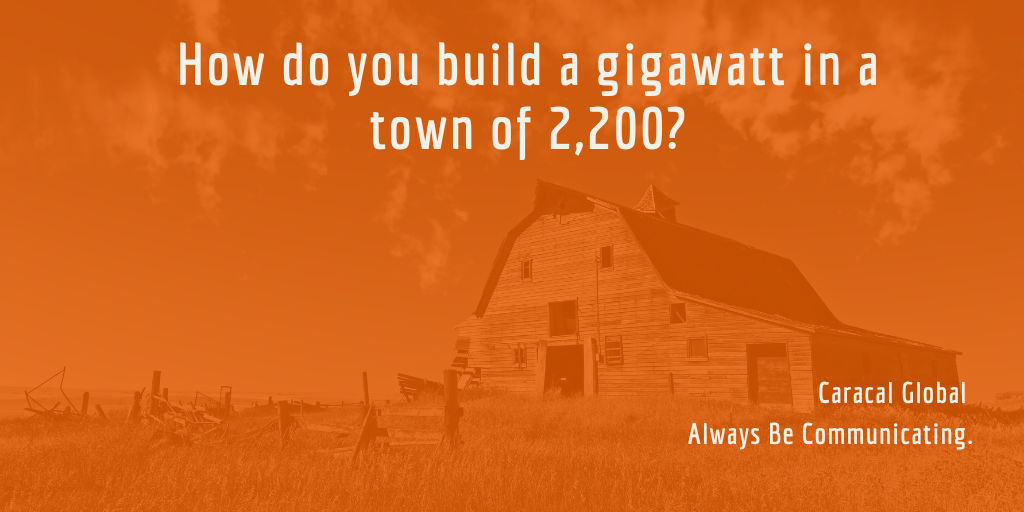
On June 1, 2026, Sam Altman stood in a Saline Township field next to Governor Gretchen Whitmer (D-MI), a row of union leaders, and a preserved red barn, and broke ground on the largest economic investment in Michigan history. A $16 billion data center campus for Oracle and OpenAI. Whitmer called it a model for the nation. Altman said the site might be where cancer gets cured.
What almost none of the coverage led with: the same township voted the project down before any of this happened. Saline Township denied the rezoning. The developer and the landowners sued. The township settled, because, as one trustee put it plainly, it could not afford to fight. Residents protested at permitting meetings. The Michigan Attorney General moved to reopen the utility contracts. And then the shovels went into the ground. Per the project's website: "Responsibly designed from the earliest stages to protect Michigan's water, land, and natural resources, The Barn is a gigawatt-scale data center campus under development by Related Digital in Saline Township, Michigan, exclusively for Oracle and its customer OpenAI."
The Barn is a smart word choice that feels All-American and evokes the warmth of a petting zoo and autumn hayrides. Ditching the engineering-correct "data center" for "The Barn" is a masterstroke in communication and narrative shaping.
All of those stories are true at the same time. That is the entire point.
Here is the question every executive should sit with: when a project announces consensus, how do you read whether the consensus is real? Because the announced version of The Barn is union jobs, preserved farmland, and a governor's blessing. The contested version is wetland loss, diesel generators, a fast-tracked utility deal, and a community that was outspent rather than persuaded.
An executive who reads only the first version is uninformed. They are marketed to.
This is a job for SIGNAL™, the framework I use with clients to read, grasp, and understand a volatile operating environment: Sources, Inputs, Geography, Noise, Analysis, Loop. I have used it for years on exactly this gap, the distance between what a situation is announced to be and what it actually is, and on closing that gap before it costs a leader.
Start with Sources. The developer's website says low water use by design. Local environmental reporting says the permits authorize the destruction of roughly 9 acres of wetlands and the operation of 15 diesel backup generators. Both are accurate. The closed-loop cooling system genuinely sips water compared to older designs. The construction genuinely disturbs wetlands and draws groundwater. A single source gives you a slogan. Reading across sources gives you the truth, which is more defensible than either side's headline.
Then Inputs. Are you drawing on a full cross-section of information, from the voices backing the project to the ones fighting it, from domestic permitting records to international best practices and industry white papers? A narrow input set produces a confident, wrong picture. The discipline is in widening the aperture before you decide what you think.
Then Geography, which can be broad or literal, and in this case, it is very literal. It is the whole story. This is the Global Great Lakes, the region that powered the last industrial era and happens to hold exactly what the AI era is starving for: a utility capable of delivering 1.4 gigawatts of power, water, a cool climate, land, and a building-trades workforce. Michigan was not chosen at random. It was chosen because the bones are already here. The same Geography that makes the site valuable to Oracle makes the Saline River and the farmland valuable to the people who live there. Read the place, and you understand both the opportunity and the opposition.
Then Noise. The word everyone used at the groundbreaking was responsible. Whitmer, Oracle's CEO, and OpenAI's CEO all invoked the need for responsible development. Oracle's Clay Magouyrk admitted that a project at this scale has not been done before and that they "learn as we go." Critics fear precisely that: that learning as they go will leave irreversible impacts. So, responsible development is the most repeated phrase in the project and the least defined. That is Noise wearing the costume of a Signal. A slogan everyone can say is not a commitment anyone has made.
And the Loop, the part of SIGNAL that asks what this environment is teaching you for next time, now points somewhere larger than Saline. The backlash that produced one township's no vote has gone national in the months since. Analysts at Jefferies have started calling data centers the villain of the 2026 midterms as Americans link them to rising electric bills. At least eleven states have proposed restrictions or bans since late 2025, and Maine is moving to halt construction outright. The anger has also turned ugly: in April, an Indianapolis councilman who backed a data center found thirteen bullet holes in his front door and a note reading "No Data Centers," and the OpenAI CEO, standing in that Saline field, had a Molotov cocktail thrown at his home weeks earlier. None of that excuses violence, and the overwhelming majority of opposition is peaceful and legitimate. But it tells you the temperature. A project that treats community consent as a box to check is now building into the hottest political environment American infrastructure has faced in a generation.
All of this shows where executives consistently get it wrong on projects like this. They treat communications as a press release after the decision. The Barn shows the opposite. The communications failure happened upstream, at the township vote, when a 2,200-person community experienced a gigawatt-scale campus as something done to them rather than something built with them. By the time the videos played at the groundbreaking, arguing the companies were being thoughtful and careful, the trust deficit was already priced in. You cannot communicate your way out of a position you communicated your way into.
The world has changed. The way you need to explain it has not caught up. Most senior executives and founders still treat communications as a tactic for explaining decisions after they are made. The ones who win in an environment like this treat communications as a strategy that shapes how an audience understands a decision before, during, and after it is made, not just an explanation after the fact. The Barn will get built.
Whether it becomes the model Altman promised or the cautionary tale his critics predict will be decided less by the engineering than by whether the people around it ever believed they were partners. Reading the environment accurately is the work of SIGNAL. Mapping the audiences inside it is the work of TWIN™. Spreading the idea once both are clear is E-STOCK™'s work.
These are the disciplines I use every day. The builders did the engineering first. The next gigawatt should do the reading first, with a focus on winning the communications from day one.
Enjoy the ride + plan accordingly.
-Marc
You can always reach me @ marcaross@gmail.com
How do you build a gigawatt in a town of 2,200?