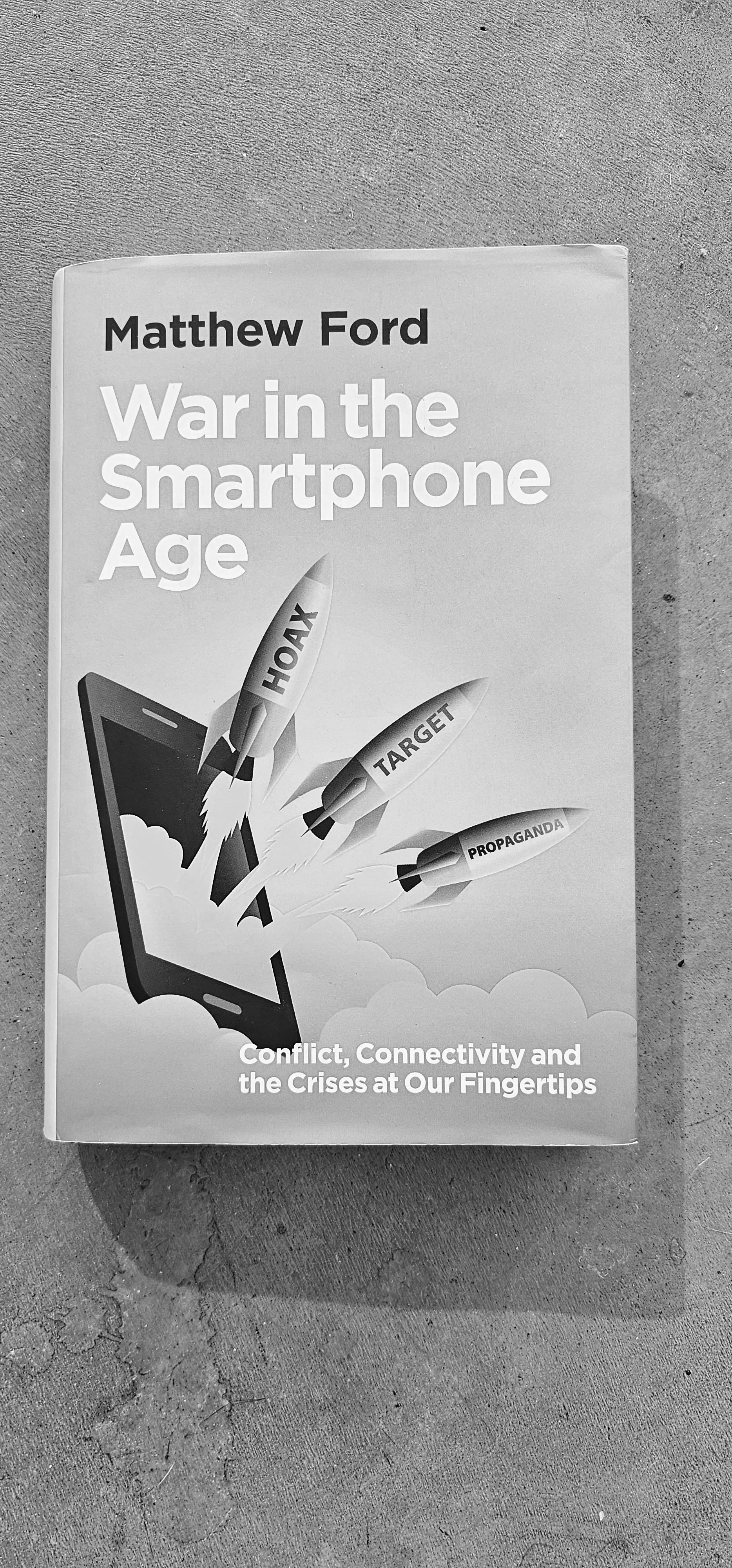
Get this on your reading list…
War in the Smartphone Age: Conflict, Connectivity, and the Crises at Our Fingertips by Matthew Ford
This book helped me better appreciate how smartphones have forever changed warfare.
Three data points:
1.) The kill chain has collapsed: Smartphones have become key technology in the kill chain, compressing the time from identification to the striking of targets and sharpening the lethality of attacks. This started with JSOC in Anbar Province in 2005, but Ukraine normalized it at scale. The implication for drone equity analysis is that the software layer — targeting, data fusion, kill-chain integration — is where the durable margin lies, not the airframe.
2) Civilian sensors are now a military network: In March 2022 at Brovary, a network of civilian drones and smartphones helped Ukrainian forces locate, target, attack, and turn back an advancing column of Russian tanks and armored personnel carriers. The eVorog app turned civilian phones into an ISR network. Ford's point is that this architecture — civilian infrastructure merging with military targeting — is now the template.
3) Surveillance capacity has outrun human analysis: Surveillance drones that could once monitor ten directions simultaneously now record in over sixty-five directions at once, with Wide Area Motion Imagery enabling a single drone to watch over twenty-five square kilometers. The enormous volume of footage produced has overwhelmed military communications, processing, and storage systems, as well as available human resources. This is the AI integration story.
The bottom-line insight from Ford is that modern warfare is no longer defined by the platform (hardware) but by the network (software).
The smartphone has "democratized" lethality. Success in this new era belongs to whoever can most efficiently process information and close the kill chain through software, rather than whoever builds the most expensive hardware.
Enjoy the ride + plan accordingly.
-Marc.
You can always reach me @ marc@caracal.global.
*****
Marc A. Ross is a geopolitical strategist and the founder of Caracal Global, a fractional Chief Geopolitical Officer service for Fortune 1,000 companies and private equity firms. He publishes the Caracal Global Daily — what a Chief Geopolitical Officer monitors every morning. Subscribe at caracal.global/contact.