
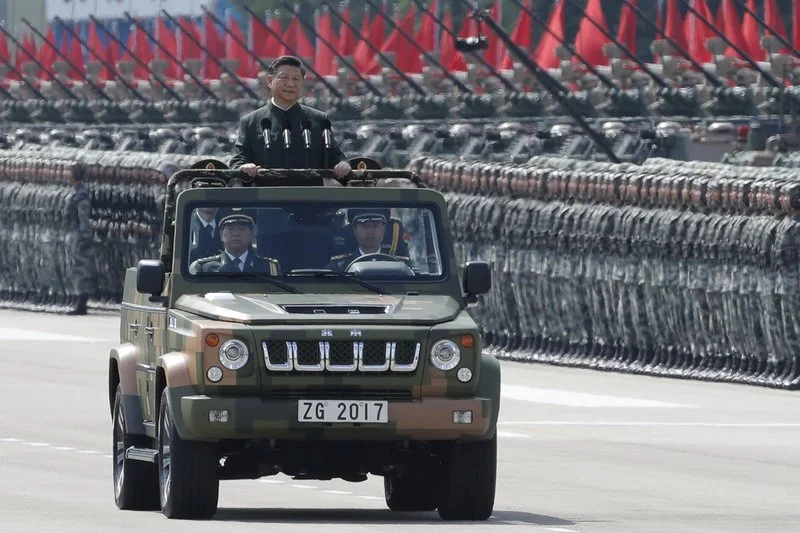
North Korea's recent h-bomb test may have been the largest man-made explosion on Earth in the last two decades. BTW, many are expecting an additional NK missile test this weekend. A massive earthquake struck off Mexico’s southern coast late Thursday night - the most powerful quake in decades. XJP continues to secure more power and authority over the PLA. The Trump, Chuck, and Nancy lovefest continues - its the new storyline for the ultimate reality show presidency. Spain's constitutional court moved to block Catalan's bid for independence. Thanks to the auto industry, Detroit's lack of a proper public transit system could hinder Michigan's bid to land Amazon HQ 2. Equifax revealed a breach exposing the Social Security numbers and birth dates of up to 143 million US consumers. BTW, several Equifax executives had the wherewithal to drop some of their shares in advance of this news becoming public. Tory Burch is developing a Royal Tenenbaums-inspired activewear line - awesome. Graydon Carter shuts it down. La Liga eyes overseas league matches - the continued march of unifying the North American and European sports marketplace continues. The 2017 NFL season, kicked off and the Kansas City Chiefs beat the New England Patriots by scoring 21 unanswered points in the fourth quarter. Asking for a friend, does "The TB12 Method" last more than three quarters of football? Sloane Stephens will meet Madison Keys in the women’s final. Syria's government is using its soccer team as propaganda during its unexpected World Cup run.
Ross Rant | September 7, 2017
The US looks to use special ops on the Korean peninsula. China is paralyzed and helped by North Korea. Poland wants to get paid. SNP has to govern. Catalonia wants freedom. Hurricane Irma makes its move to Florida.Trump backs Nancy and Chuck for a stop-gap budget deal. Facebook is on the path to campaign and political regulation. Nokia and Ericsson reduce staff levels. Americans didn't go to the movies this summer. Amazon is such a powerhouse it is looking to build a second North American headquarters - my bet is on Detroit. The NFL has become a political football - Kaepernick and Elliott top the headlines.
For more news and analysis, read today's edition of Caracal Insider | Daily here: http://mailchi.mp/caracal/ci090717?e=2a1b60aa89.

Business Schools Need to Teach Less Math and Management and Teach More Policy and Politics

Marc A. Ross
Diplomatic Courier
August 31, 2017
Nearly 200 years ago in 1819, the Ecole Spéciale de Commerce et d’Industrie (now ESCP Europe) in Paris established what is widely recognized as the world’s first business school.
Sixty-two years later in 1881, the University of Pennsylvania’s Wharton Business School was established as the first collegiate school of business in the United States. And it wasn’t until 1948 when the Ivey Business School at the University of Western Ontario in Canada was the first college outside of the United States to offer an MBA program. One year later, 25 students enrolled in the MBA program offered by the University of Pretoria’s Graduate School of Management in South Africa.
Now, of course, the MBA degree is a global phenomenon and offered at hundreds of business schools around the world in both developed and emerging markets. Captains of industry, visionary entrepreneurs and even a handful of elected politicians and diplomats hold this advanced degree.
However much of the course work has changed little. Sure there may be more case studies these days. More and more schools are partnering to offer global immersions and study abroad programs. Also, there has been an expansion of coursework to support softer management skills like developing a high-performing culture, business ethics, and human resource management.
What is missing from the course catalog I fear is not enough classes to prepare future executives to manage a more engaged political and globalized world. The world that every day is at the intersection of global business and global policy. It is time for business schools to teach less math and management and more policy and politics.
Globalization has significantly changed the nature of global politics and the demands placed on business to ensure civil stability and services in domestic and foreign markets. Without knowledge and an advanced educational foundation, how future business executives proceed in this new environment is a risky unknown.
Just the election of Donald Trump alone has uniquely changed the liberal world order into something entirely different than it was just four years ago. In the short term, America’s politics will spill around the world forcing business and civic leaders to manage a shifting and a never seen before business environment. As Trump attempts to redefine America’s role in a liberal world order, how does a global business executive lead a multinational organization lacking a clear understanding of populism, election, and the whims of voters? Without a foundation of study in history and economics and an over-reliance on the scientific management of business, future business leaders will be ill prepared to handle the challenge.

With an endless news cycle, a continuous flow of global trade, protectionist laws, and committed geopolitical powers, global politics and global business is being shaped from many directions and far beyond a nation’s borders and a company’s boardroom. Decisions made in Beijing now affect events in Brussels which in turn compels policy in Ottawa and then again impacting Santiago.
The ability to manage this dynamic, globalized political environment, particularly at the intersection of public policy global business, coupled with an underlying cultural phenomenon rejecting the establishment, this new environment is more challenging for business leaders and global companies.
The pace involved in addressing global business challenges has increased as well as, with the scale of the problems expanding to an ever-growing globally diverse network of stakeholders. Disenfranchised and left-behind voters around the world have spoken and demanded a greater share of the profits. The traditional capitalist ideal of being responsible solely to shareholders in under threat and business going forward will involve numerous stakeholders, including governments, media, bloggers, consumers, non-governmental organizations, investors, employees, and citizens.
For future business leaders, simply put, there are a lot more people that will hold you accountable and want a say in the process. Having a genius marketing plan and solid accounting skills won’t be enough.
The time is now for MBA programs to recognize this challenging global public affairs environment. It is critical that classes utilize case studies that explore the nexus between multinational corporations, non-governmental organizations, government officials, institutions, investors, and recent elections.
World-class business leaders will need to excel with a foundation of fundamental business management skills, but they must be equally deft at grasping the intersection of history, politics, geography, culture, and economics to manage this new global business paradigm.
MBA programs must prepare future business leaders with the hard and soft skills to understand and engage global problems, comprehend economic development challenges and opportunities, and connect how these issues spread in a globally interconnected marketplace all influencing and disrupting global politics and global business like never before.
About the author: Marc A. Ross is the founder of Caracal Global, a strategy firm specializing in global business communications, an adjunct professor at George Washington University teaching a course on Globalization and American politics, and former communications director for the US-China Business Council. Ross holds an MBA from UNC Kenan-Flagler Business School.