

A t-shirt's tour: African countries Rwanda, Kenya, Uganda, Tanzania, South Sudan, and Burundi are trying to phase out imports of secondhand clothing and shoes.
The foreign hand-me-downs are blamed by the governments of these nations for hampering the development of a textile industry in their respective countries. They have a point.
The textile industry has long required a vast number of low-end, low-skilled, and low-paid workers but can serve a nation as a gateway to advanced manufacturing and assembly.
Africa has the ideal employment base to be a textile powerhouse. African leaders know full well that the textile industry is the perfect stepping stone to power an economy and have seen for themselves the success such a move has made for counties all over Asia. Not only Asia, but the United States in the early days of the republic used the same economic development strategy as America harnessed the power of the textile industry to move the up the manufacturing ladder.
Here's a great book to read on this very subject: The Travels of a T-Shirt in the Global Economy by Pietra Rivoli, a Professor at Georgetown University's McDonough School of Business.
Faux-fur: Gucci will stop using fur in its products starting in 2018. The world-class fashion house added heft to a growing chorus of luxury companies going fur-free.
Independence for Scotland: It has been three years since Scotland’s unsuccessful independence referendum. However, the desire to leave the UK still burns with the nation's leaders. The outgoing leader of the Scottish National Party (SNP), Alex Salmond, stated at the party's annual conference this week, “for Scotland the campaign continues, and the dream will never die.”
Salmond's dream of breaking away from the UK is not finished and will always be present with many across the highlands and lochs of Scotland, but the goal of independence has clearly moved to the back burner and is a little dimmer these days.
Ross Rant | October 11, 2017

Spain update: Catalan President Carles Puigdemont says the region has earned right to secede but calls on lawmakers to suspend action to allow negotiations with Madrid. The move stopped an immediate declaration of independence from Spain. This decision doesn't end the crisis; it only draws out the tense political standoff between Catalonia’s government and Madrid.
US Men's soccer: Playing a team ranked 99th in the world and nothing to play for, the US only needed a draw against Trinidad and Tobago to ensure passage to the world's biggest soccer stage. The Americans failed. So the US Men's National Soccer Team will miss a World Cup for the first time since 1986.
As a side note, before 1986 and regular appearances, the US was on a four-decade World Cup absence. The impact due to the loss of this match cannot be stressed enough. The idea that I could see an American side win a World Cup in my lifetime seems fanciful.
Twenty years’ worth of investment, player development, and improved sophistication were supposed to have paid off. It did not. Missing a World Cup is a total and complete disaster for American soccer.
China's future: Wang Qishan could be the most critical person in the Middle Kingdom.
Alibaba and real competition: Alibaba has announced it will spend $15 billion over the next three years to increase research and development - indeed a positive and much-needed move. But does it matter? Is this just press release - feel-good - public relations?
If you look at the Chinese marketplace from a macro view, you see big Chinese companies with big budgets and big protectionism schemes that ensure success coupled with an uneven playing field for foreign competitors. From a complete lack of market access in some sectors to the unequal application of local laws, it is a challenge for international companies to be successful in China.
This protectionism ensures China's has winners with fancy companies that appear prominent and successful.
But looks can be deceiving.
What is hard to know is if Alibaba's R&D spend will work in 10-15 years.
The company is protected from a real marketplace challenge in China and hasn't had to compete against Jeff Bezos an
How good is Jack Ma and Alibaba since they are protected and selected as the Chinese e-commerce winner?
Ross Rant | October 10, 2017
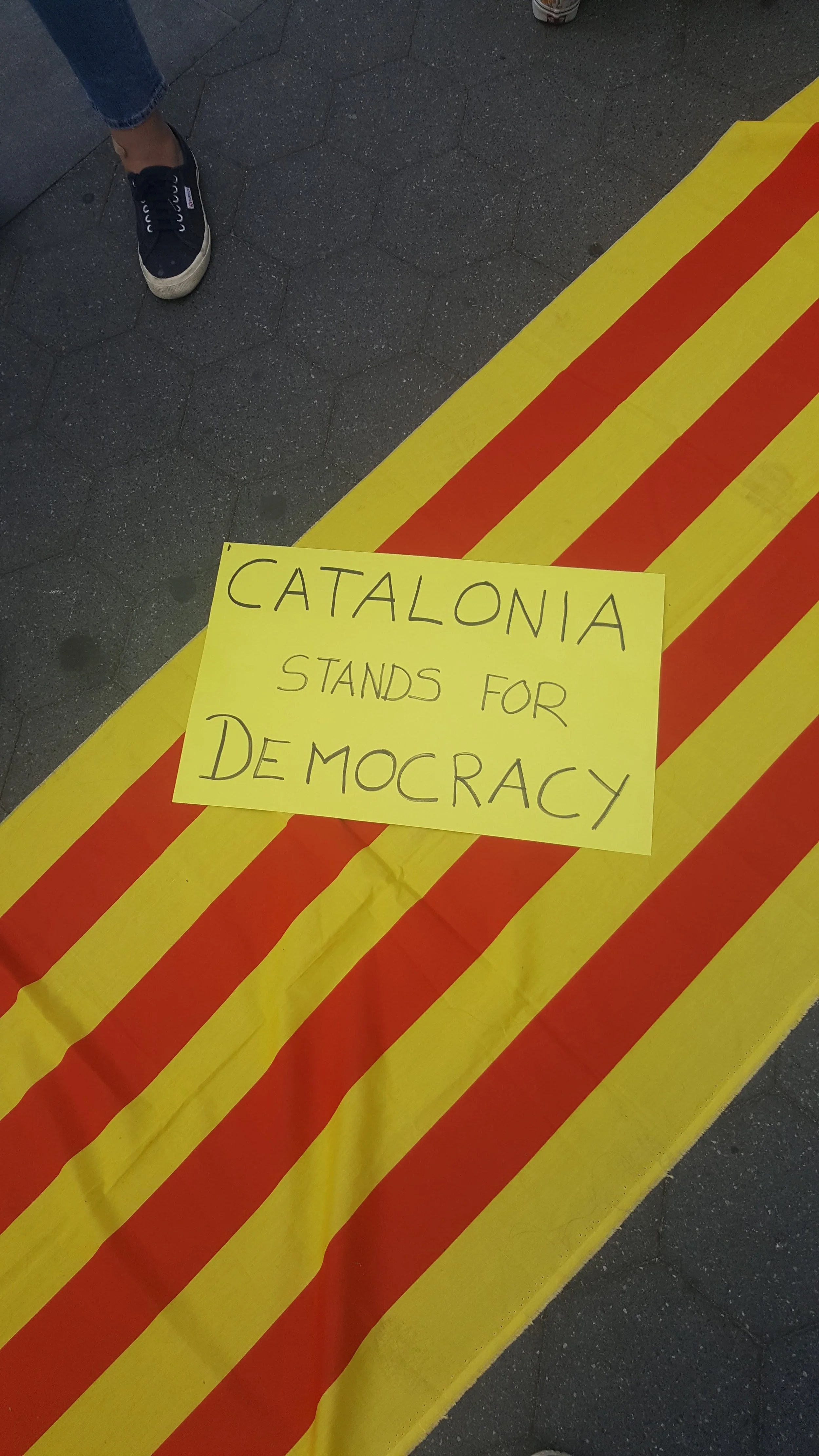
Photo by Marc A. Ross - taken at Washington Square - New York City on October 7, 2017.
Spain: The Catalan parliament meets today to consider a declaration of independence that will draw a sharp reaction from Madrid.
Spanish police are ready to arrest Catalan President Carles Puigdemont immediately if he declares independence in the regional parliament.
The current thinking is Catalan president is likely to use the words “declaration of independence,” but they will probably be qualified or hedged in some way.
This is developing story.
Turkey: Ankara’s escalating tit-for-tat spat with the US is putting Turkey’s position in NATO at risk. Relations between the nations have frayed following a failed coup against Erdogan in July 2016 - but nothing has been this bad.
Turkey’s decision to detain a staff member working at the United States consulate in Istanbul on an espionage charge has provoked a halt on all non-immigration visas being issued to Turks wanting to travel to the US.
US Ambassador to Turkey John Bass said he quote ‘can’t predict’ how long crisis will last. The tension has sent the Turkish markets into a tailspin.
Silicon Valley: Washington is clashing with Silicon Valley once again - this time it's all about democracy.
Both the House Intelligence Committee and the Senate Intelligence Committee plan to grill senior executives from Facebook, Google, and Twitter on November 1.
Facebook and Twitter have confirmed they plan to send a representative to speak only at the Senate hearing and there no word yet on what Google plans to do.
Also, it is unclear how senior the executives will be. I can assure you the GR and PA teams of these companies are doing all they can to make sure it won't be at the CEO level. No doubt these hearing will be a grandstanding circus and members of these committees will do all they can to humble the smartest geeks in the room.
Xi's second term: The most important date for the most important gathering of China's 2017 political calendar is now set: October 18.
That's the date announced for the start of the 19th national congress of China's ruling Communist Party, an essential gathering that takes place every five years.
First, this meeting with mark the end of Xi Jinping's first five-year term as head of the Communist Party of China and a number of senior members of the Party are expected to retire. In addition to making leadership changes, the national congress also reviews and makes changes if necessary to the Party's Constitution as well as selects the Central Committee, a powerful decision-making body.
There is no doubt that Xi Jinping will stay for a second term, but the real question for the national congress is who will join Xi on the Politburo and the Standing Committee - essential bodies that will influence commercial policy, economic reforms, and American businesses operating in China the next five years.
Also, the outcome of gathering will provide an early indication whether Xi may break with recent precedent and stay for a third term (2022-2027) - a move which will lead to a new dynamic for American companies selling goods and services to the Chinese marketplace.