Insight | My hot take on the TikTok hearing

Geopolitics is disrupting every business.

Just ask TikTok and Shou Zi Chew.

Even so, my first impression is that TikTok will keep operating in America for some time mainly because there is no one reason to ban, limit, or halt its operation - Congress has 20 reasons.

In the hearing, Congress came across as seeing all problems in American society as problems TikTok can solve, reduce, or protect.

It won't be easy, and there will be loads of friction and regulation, but I am long TikTok operating amongst the US civilian population for the foreseeable future.

A complete lack of focus on Capitol Hill to prioritize at max three policy issues on China helps TikTok survive.

Congressman Tim Walberg's (R-MI-05) questioning gave up the game.

TikTok is a proxy to show how much Capitol Hill is overwhelmingly frustrated with the Chinese Communist Party (CCP) and concerned with the CCP's global intentions was the foundation of this hearing.

TikTok CEO Shou Chew did well, all things considered - calm, confident, cooperative, and concise. His preparation was world-class, and his manner is a template others in a hearing hot seat should emulate.

Equally, the committee members asked legitimate questions with limited grandstanding, which is amazing, frankly. Plus, the staff did a bang-up job researching and prepping their members.

This was a "welcome to the bigs" hearing for all participants.

The main geopolitical business communications takeaway, from now on, commerce without geopolitics is nearly impossible.

If you need help sorting out how your business will operate in this hothouse, interconnected geopolitical business environment, Caracal is here to help.

Problem-solving communications for business here

Enjoy the ride + plan accordingly.

-Marc


ITK Daily is geopolitical business intelligence for senior executives with global ambition.

ITK Daily curates news @ the intersection of globalization, disruption, politics, culture, + sport and provides actionable insights and sharp commentary.


The solo marathon + The Barkley Marathons

No finishers for the past seven years and only 15 finishers in 35 years of Barkley Marathons.

The race, considered to be the most brutal ultra-run in the world, started today.

The Barkley Marathons is one of the most challenging races in the ultrarunning world.

Inspired by a jailbreak, race founder Gary "Lazarus Lake" Cantrell created the mysterious race, which runs in late March or early April in the Tennessee hills.

In 1977 James Earl Ray, the man who assassinated Martin Luther King Jr., escaped from Brushy Mountain State Penitentiary in the town of Petros in Morgan County, Tennessee.

A massive manhunt ensued for the escaped murderer in hills and hollers, with Ray only making it roughly eight miles in the 55 hours since he jumped the prison walls before being captured.

Cantrell said to himself, "I could do at least 100 miles," mocking Ray's low mileage.

Launched in 1986, the race is limited to only 40 participants yearly.

The field consists of runners of all abilities, from elite runners to people

Cantrell says have no business there.

If accepted into the race, you receive a letter of condolences from Cantrell.

First-timers—or "Barkley virgins," as Cantrell calls them—are also asked to bring a license plate from their state or country.

Plus, the competition starts at an unknown time, between midnight to noon on race day, with one hour till the race start signaled by blowing a conch.

Finally, the race officially begins when Cantrell lights a cigarette at the start line.

Beyond past competitors, the course is not well-known, and only that it takes place in the Cumberland Mountains within Frozen Head State Park, located in Wartburg, Tennessee.

To complete the marathon, one must run, walk, and crawl five 20-mile loops in less than 60 hours.

The elevation is one of the most notable challenges of the race.

If you complete all five loops, the total elevation gain is the equivalent of climbing Mount Everest twice.

Situated on the Cumberland Plateau, a segment of the great upland extending from western New York to central Alabama, the area is the world's most extensive hardwood-forested plateau. Rugged terrain, a moderate climate, and abundant rainfall characterize the plateau.

Carved by flowing water, the plateau is a labyrinth of rocky ridges and verdant ravines dropping steeply into gorges with waterfalls, caves, ferns, and rhododendrons.

The Cumberland Plateau remained a remote and rugged paradise for thousands of years. Barren soil and rocky terrain discouraged early settlement.

Artifacts found in caves and rock shelters suggest Mississippian and later Cherokee hunters camped here but never established permanent dwellings.

English, Scots-Irish, and German settlers staked their claims mainly in the valleys and ventured to the plateau only sporadically to mine coal and harvest timber.

John Muir was one of the first naturalists to document the natural bounty of this area. He memorialized his crossing of the Cumberland Plateau in the book A Thousand-Mile Walk to the Gulf.

Being in such hardwoods and dampness, the runners are subjected to thorns, briers, slick leaves, slippery rocks, and other unpleasantness to run through. Runners often return from a loop battered and cut up.

Plus, anyone who knows the weather that batters the region at that time of year knows it will be wet, cold, damp, miserable, and wet again.

Only 15 individuals have ever completed the race.

Mark Williams (1995)

David Horton (2001)

Blake Wood (2001)

Ted Kaiser (2003)

Mike Tilden (2004)

Jim Nelson (2004)

Brian Robinson (2008)

Andrew Thompson (2009)

Jonathan Basham (2010)

Brett Maune (2011, 2012)

John Fegyveresi (2012)

Jared Campbell (2012, 2014, 2016)

Nick Hollon (2013)

Travis Wildeboer (2013)

John Kelly (2017)

But even if one is not adventurous enough for a run in the Tennessee hills, I spotted this ditty from Seth Godin:

The solo marathon

The usual marathons, the popular ones, are done in a group.

They have a start time.

A finish line.

A way to qualify.

A route.

A crowd.

And a date announced a year in advance.

Mostly, they have excitement, energy, and peer pressure.

The other kind of marathon is one that anyone can run any day of the year. Put on your sneakers, run out the door, and come back 26 miles later. These are rare.

Much of what we do in creating a project, launching a business, or developing a career is closer to the second kind of marathon.

No wonder it's so difficult.

-Marc


ITK Daily is geopolitical business intelligence for senior executives with global ambition.

ITK Daily curates news @ the intersection of globalization, disruption, politics, culture, + sport and provides actionable insights and sharp commentary.


The geopolitics of AUKUS + business implications

In September 2021, the United States launched an unprecedented trilateral security partnership with the United Kingdom and Australia.

A deal that calls for Australia to build a fleet of world-class nuclear-powered submarines.

A deal forged as a bulwark amid rising tensions with China over disputes ranging from the South China Sea to Taiwan to shaping the governance of the amorphous Indo-Pacific region.

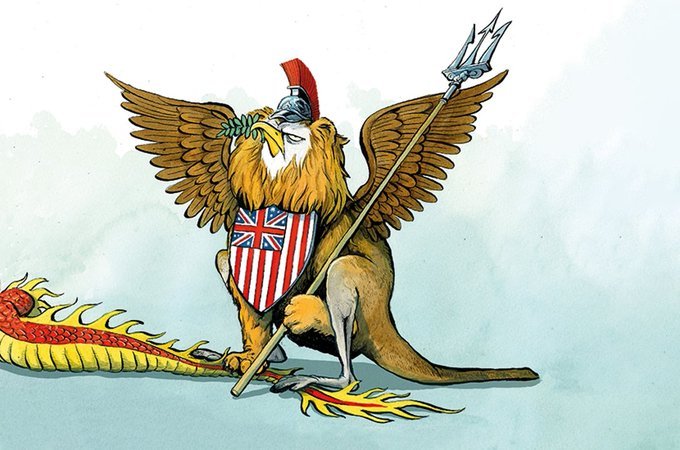
Most certainly named by a bureaucratic committee and not by communications pros, the clunkily named AUKUS or Australia, United Kingdom, and United States security pact is the most significant security arrangement among the three countries in a generation.

According to the Congress Research Service, attention initially focused on the proposed transfer of nuclear propulsion technology to Australia; however, observers now say the pact's plan to develop advanced technologies and other military capabilities over the longer term may prove to be equally significant.

AUKUS is not a submarine deal.

Forty-one nations have submarines.

Any nation that wants a submarine can get a submarine.

But only six nations have submarines that have nuclear propulsion.

Any nation wanting a submarine with nuclear propulsion needs the technology.

A nation can build nuclear technology.

A nation can borrow nuclear technology.

A nation can buy nuclear technology.

A nation can even steal nuclear technology.

In coordination with the United Kingdom, the United States is boldly moving into the future of global security.

The United States is now sharing the crown jewels of its military technology, nuclear propulsion, with an ally for only the second time in 65 years (the other time being with Britain).

The sharing of America's crown jewels of its military technology opens the door for nearly all knowledge to head to Oz.

In April 2022, AUKUS leaders committed "to commence new trilateral cooperation on hypersonics, counter-hypersonics, and electronic warfare capabilities" in response to China's tests of its hypersonic missiles, which Chairman of the Joint Chiefs of Staff General Mark Milley described as "very concerning."

AUKUS is like the Berlin Wall falling.

Antoine Bondaz, a Research Fellow at the Fondation pour la Recherche Stratégique, wrote that for China, the pact between Washington, Canberra, and London is "the realization of a longstanding fear: the multilateralisation of American alliances in the region. Today, it's Australia and the United Kingdom. Tomorrow, maybe Japan will join."

Later this afternoon, President Joe Biden will reveal the latest AUKUS nuclear submarine plans alongside United Kingdom PM Rishi Sunak and Australian PM Anthony Albanese at Naval Base Point Loma.

Politico reports that the event in San Diego, which could include a walk atop a submarine, will feature details on how Australia aims to acquire nuclear-powered submarines.

The geopolitical business implications of AUKUS are three-fold:

1) The AUKUS alliance will further stabilize the friendship between the United States, Australia, and the United Kingdom, securing this trilateral relationship for generations.

2) AUKUS will be a lasting feature of British foreign policy and the clearest example of what the tilt to the Pacific and the talk of 'global Britain' actually means. Between the launch of the magnificent HMS Queen Elizabeth (R08) and this deal, the United Kingdom is sending a strong signal to its reversion as a proper global seapower.

3) For Washington, Canberra is becoming more critical than London daily. Businesses should look for continued commercial opportunities in Australia and the Indo-Pacific region.

AUKUS is a big bet.

A big bet that places energy, resources, technology, and the attention of Australia, the United Kingdom, and the United States firmly in the Indo-Pacfific for multiple generations.

If you need help with geopolitical intelligence, Caracal is here to help.

Caracal lives and breathes at the intersection of globalization, disruption, and politics, home of the world's most savvy participants.

Caracal can help you navigate today's interconnected geopolitical business environment. Learn more here.

Enjoy the ride + plan accordingly.

-Marc