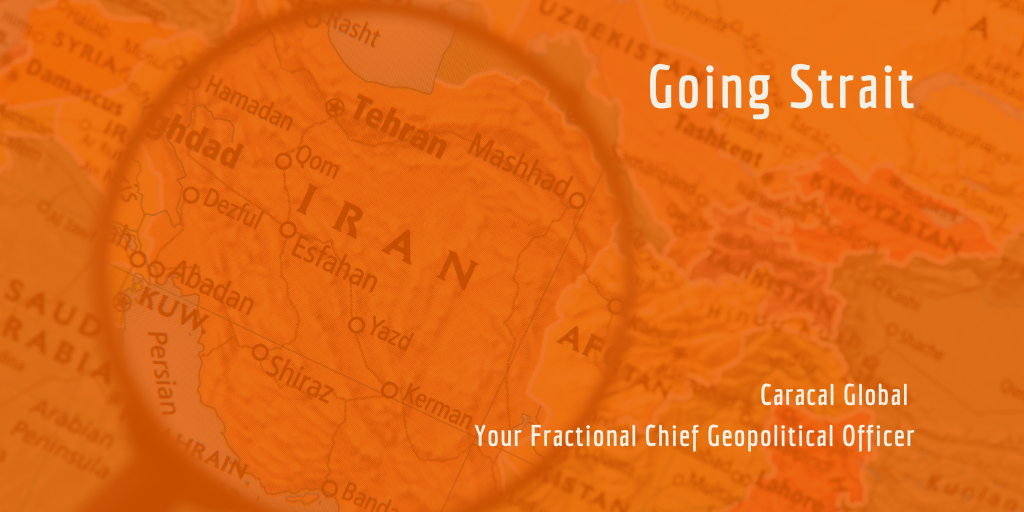
Going Strait

Three weeks ago, the Strait of Hormuz appeared in most corporate risk frameworks as a scenario — something flagged in annual reviews, noted in board presentations, and rarely acted upon. That era is over. Iran has demonstrated something that will outlast this conflict: closing the world's most critical shipping chokepoint is achievable, the United States cannot reopen it quickly or alone, and the economic consequences radiate far faster than any military response can contain them.

Drone strikes on Dubai's airport. Cyberattacks that knocked tens of thousands of Stryker employees offline. Satellite imagery of the Middle East is quietly disappearing from open-source intelligence feeds. Jet fuel prices are rising, and airlines are rerouting flights. An Emirates flight that departed Dublin, flew for ten hours, and turned back. This is not a regional conflict. It is a systemic stress test for the global economy — and most executive teams are still treating it like a headline rather than an operating reality.

The pattern this week is unmistakable. Trump bet that Iran would capitulate before closing the Strait. It didn't. US allies are declining the White House's call to send warships: Japan cites legal constraints, Britain says it won't be dragged into a wider war, Australia has declined, and Spain calls the conflict a threat to the global order. China — the country with the most genuine diplomatic leverage over Tehran — has no incentive to use it, particularly now that Trump is threatening to cancel the Xi summit as a pressure tactic. India is conducting quiet diplomacy and claiming results. Gulf states are recalculating their exposure. And Iran's drone and missile arsenal, cheap, plentiful, and battle-tested, is producing a conflict unlike anything the US military has faced in recent decades.

Three things your leadership team needs to act on now.

1. Energy cost assumptions for 2026 are wrong. Oil executives have already told the White House the fuel crunch will worsen. If your planning models reflect pre-war energy prices, rebuild them this week—Stress-test at $110, $120, and $130 per barrel. The Hormuz closure is not short-term noise. It has the structural characteristics of a prolonged disruption.

2. Semiconductor exposure is more immediate than most companies recognize. The war is threatening the helium and sulfur supplies that Taiwan's chipmaking sector depends on — and Taiwan Semiconductor alone accounts for roughly a fifth of Taiwan's economy. A sustained disruption cascades through consumer electronics, automotive, and industrial production, with limited lead time to respond. Procurement teams need contingency postures now, not in Q3 when the damage is already compounding.

3. Government affairs and corporate diplomacy are your most underutilized strategic assets in this environment. The countries navigating the crisis most effectively — India, Canada, the Nordics — are doing so through sustained diplomatic investment and active relationship capital. Your company needs the equivalent: direct access to decision-makers in the markets where you operate, intelligence on where policy is moving, and a communication strategy that positions your organization as a constructive actor rather than a reactive one.

Hormuz has demonstrated to every strategic adversary what is achievable at scale. The next disruption will come faster, from a different chokepoint, and with less warning.

This is precisely why Caracal Global exists. We specialize in global business issues at the intersection of globalization, disruption, and politics. We provide Fortune 1,000 companies and PE portfolio firms with fractional Chief Geopolitical Officer services — combining intelligence, strategy, and communications to help senior executives navigate today's interconnected business environment before a crisis becomes a cost. You need a CGO. You are not ready to hire one full-time. Caracal Global is your fractional solution.

Enjoy the ride + plan accordingly.

-Marc

*****

Marc A. Ross is a geopolitical strategist and the founder of Caracal Global, a fractional Chief Geopolitical Officer service for Fortune 1,000 companies and private equity firms. He publishes the Caracal Global Daily — what a Chief Geopolitical Officer monitors every morning. Subscribe at caracal.global/contact.
The war nobody planned to win

Eleven days into Operation Epic Fury, the most honest thing anyone in Washington can say is this: the United States started a war without an endstate.

Here is the pattern business leaders need to understand.

The Iran war is not one crisis. It is five overlapping crises arriving simultaneously: a munitions sustainability problem, an energy market shock, a Hormuz chokepoint that gives Tehran leverage despite military losses, a humanitarian emergency in Lebanon that is escalating rapidly, and a multi-decade allied coalition fracturing along national-interest lines in real time. France is playing broker. Germany is warning against endless war. Canada has drawn a clean line. The coalition of the willing does not exist in this Middle East conflict.

The Strait of Hormuz dimension deserves direct attention. Iran does not need to win militarily to destabilize global commerce. It only needs to mine the strait, threaten shipping, and raise transit costs. The US reports it has destroyed 16 Iranian minelayers. That is not reassurance — it is confirmation that the threat is active and ongoing. The LNG tankers already rerouting from Europe to Asia are the market's honest assessment of the risk.

Trump is scheduled to visit Beijing starting on March 31. This diplomatic visit to the Middle Kingdom is the most consequential signal inside all of this noise. A presidential visit to China while actively engaged in the Middle East conflict tells you something essential: Washington is managing its great power relationships carefully and does not want a two-front strategic environment. That visit will reshape the trade, technology, and geopolitical operating environment for the rest of 2026. Every company with US-China exposure should be watching the agenda, the tone, and what does not get said.

Three concrete implications for executives reading this today.

First, energy costs are not a short-term problem. They are a structural repricing that will shadow your cost base into 2027. Model it explicitly. Saudi Aramco's CEO used the word "catastrophic" if the Iran war drags on. He does not use language carelessly.

Second, the expansion of executive power documented in the Washington Post this week is not temporary. The president has started a war and levied sweeping tariffs, marking a major expansion of executive power at the expense of the legislative branch. Congress has ceded war authority and tariff authority to the White House with minimal resistance. That means policy can move faster, with less predictability, and with fewer legislative circuit breakers than your government affairs team is probably modeling. Update the assumption.

Third, supply chain repositioning is no longer a planning exercise. Apple now makes about 25% of iPhones in India after its China pivot. The company assembled about 55 million iPhones in India in 2025, up from 36 million a year earlier, with India's share of the total increasing rapidly. The companies that moved early are building durable cost and resilience advantages. The window is open — but it is not unlimited.

The war in Iran will end eventually. However, the volatility of global commerce will not end. The conflict has accelerated: energy market instability, allied fragmentation, executive branch unilateralism, and the great-power realignment are evident in every headline this week.

Enjoy the ride + plan accordingly.

-Marc

*****

Marc A. Ross is a geopolitical strategist and the founder of Caracal Global, a fractional Chief Geopolitical Officer service for Fortune 1000 companies and private equity firms. He publishes the Caracal Global Daily — what a Chief Geopolitical Officer monitors every morning. Subscribe at caracal.global/contact.
Ideas are rarely built in a boardroom

A boardroom is a place of CYA, one-upmanship, committees, factions, spreadsheets, cost allocation analysis, and financial statements.

A boardroom is ties, suits, starched collars, wingtips, multiple chairs that are hardly ever comfortable, and massive tables that ensure friction.

At one startup I worked at, when the founders gleefully told me they had purchased a proper boardroom conference room setup, I knew our days were numbered.

Boardrooms are about hierarchy, who sits where, who can speak when, status, seniority, and pressure to maintain a severe meeting vibe. Far more important is to create an environment and a culture where everyone feels safe being heard and where unfamiliar concepts are welcome. This is precisely why geopolitical strategy—the thinking that separates companies that anticipate disruption from those that react to it—rarely emerges from traditional boardroom settings. When tariff cycles, supply chain disruption, and government relationships become operational imperatives, the hierarchies and constraints of the boardroom often stifle the unconventional thinking required to navigate them.

Caracal Global exists to solve exactly this problem: to bring geopolitical intelligence and strategic thinking into the conversation outside the formal structures where traditional boardroom politics take hold. For Fortune 1,000 leaders navigating the intersection of globalization and American politics, the best strategic insights happen when you step outside the usual room—and have a guide who understands both the threats and the opportunities.

The best ideas come when you step out of the office.

For me, it could be a walkabout, on a chairlift, watching a documentary, listening to jazz, seeing world-class art, or being behind the wheel.

One time on a drive through the Virginia countryside, I had conjured such a brilliant idea that it cost me a speeding ticket. I was so in the zone, DJ Doran: Monuments blasting from the sound system, high on Red Bull and PayDay. There it was—boom—a brilliant idea literally speeding across my mind. The state trooper was unfazed by my sensational out-of-the-boardroom idea-generation tool; he told me to slow down and pay the fine.

What's your idea generation tool?

By stepping out of the boardroom and into a more realistic, real-life setting, you allow yourself the freedom to generate new ideas.

I grew up with an active family dinner table discussion. Growing up, we had to go around the table and announce five things we learned that day. This taught me that regardless of age or station, all voices at that table were equal, and we were encouraged to share ideas and concepts from politics to sport, from business to culture—frankly, anything. The exercise wasn't about the content but about the ability and freedom to recognize and share ideas.

Knowing when or where your next great idea might come is hard. But stepping out and embracing the life around me has been a positive tool for generating new ideas. From a walkabout on the shores of the Potomac River or a drive on VA State Route 20, it won't be in a bored room.

Enjoy the ride + plan accordingly.

-Marc