The alliance that isn't

Here is what happened yesterday.

The United States went to its allies and asked for help opening the Strait of Hormuz. France said no. Canada said no. Europe said no — collectively, formally, and on the record. Trump responded by declaring he no longer needs them.

This ask, deny, and rejection will be studied in foreign policy programs for a generation. For the executives reading this, it has a more immediate meaning: the Western alliance architecture your company has operated within for 80 years now has a visible crack. Not a hairline fracture. A load-bearing one.

Understand the structural dynamic. The US launched a military campaign without NATO consultation, alongside Israel, and then asked its allies to help manage the operational consequences.

European leaders — facing domestic opposition, energy market chaos, and populations who did not vote for this war — declined. That is not moral weakness. It is a political reality.

Three business implications arise from this week's news.

First, allied divergence is accelerating. If the US and Europe are operating from genuinely different strategic postures — not just rhetorically but in terms of actual military commitments, sanctions enforcement, and alliance obligations — the compliance environment for multinationals operating across both jurisdictions will continue to diverge. Export controls, sanctions compliance, data governance, AI regulation: these were already moving in different directions. They are now moving apart with political legitimacy on both sides. This allied divergence cannot be managed with a single government affairs strategy and nice diplomacy. You need distinct, jurisdiction-aware approaches — and you need them now.

Second, energy markets are no longer a managed risk. They are an unmanaged one. Oil above $100 globally, $150 in Oman, the world's most consequential maritime chokepoint under active blockade, no coalition to restore navigation, and a senior US counterterrorism official resigning in protest: there is no clean off-ramp visible from here. CFOs who built Q2 guidance on pre-war energy assumptions need to revisit those numbers. The scenario where this drags into summer is not a tail risk. It is the base case.

Third, the China-Russia axis is consolidating while Washington is occupied elsewhere. Moscow is arming Iran with satellite imagery and drone technology. China is absorbing the energy shock and positioning for post-war strategic advantage. Trump's China visit has been quietly delayed until who knows when. The autocratic coordination report released this week is not an abstract analysis. It describes China-Russia operational infrastructure — shared media, forums, personnel exchanges — that is currently in place while the US is distracted in the Gulf. Companies with significant China exposure need to ask a harder question: what decisions is Beijing making this quarter, in the window of reduced US attention?

The deeper pattern is one Caracal Global has been tracking since January. Geopolitical volatility is no longer episodic. It is structural. The Iran war, the Western alliance fracture, the domestic political ruptures within the Trump coalition — these are not crises that resolve into a stable baseline. They are recalibrations of the operating environment. The baseline has moved.

Your board needs a Chief Geopolitical Officer in the room — not a consultant on retainer for quarterly check-ins, but a strategic partner monitoring this environment daily and translating it into decisions your company can act on before the headlines force your hand.

That is what Caracal Global provides. Fractional CGO services for Fortune 1,000 companies and PE portfolio companies. Intelligence. Strategy. Communications. If the last two weeks have made it clear that your organization needs this capability, let's have that conversation. Drop me an email @ marc@caracal.global.

Enjoy the ride + plan accordingly.

— Marc
There is no billion-dollar bracket, just a marketing campaign

Kalshi just announced a $1 billion prize for a perfect March Madness bracket.

They will not pay it. Bet on it.

The math makes it impossible.

And they know it. This is one of the most elegant free marketing campaigns in recent memory, and every business leader should take notes.

Consider that every NCAA tournament game was a pure coin flip, your odds of a perfect 63-game bracket are 1 in 9.2 quintillion. A quintillion has 18 zeros. Fine, let's be generous. Credit expert basketball knowledge. Account for seeding, form, and injury reports. Statisticians estimate the realistic odds fall somewhere between 1 in 120 billion and 1 in 1 trillion.

Pick your number. It doesn't matter. You won't win.

Kalshi's $1 billion prize is backed by SIG Parametrics, a member of the Susquehanna International Group of Companies that helps Kalshi manage trading risks.

This is not a leap of faith. It is actuarially risk-free.

Warren Buffett tried the same play in 2014 through Quicken Loans.

One billion dollars for a perfect bracket. The best entry that year didn't survive the first round with a perfect record.

Nobody came close. Nobody ever does.

So what if you actually tried?

Here is where it gets interesting.

Suppose you built the best bracket-prediction system ever created.

World-class data science. Elite sports modeling. A proper $25 to $30 million investment in talent and infrastructure. You would get to 75% accuracy per game. That sounds impressive. Run it across 63 games, and your odds of a perfect bracket improve from 1 in 9.2 quintillion to roughly 1 in 290,000.

Better, but still significant downside risk.

The theoretical ceiling for correctly predicting any individual game is around 75-80%. Basketball is not a deterministic system. Upsets happen. Buzzer beaters happen. Players twist an ankle in warmups. Even a god-tier model cannot solve for chaos.

So what is Kalshi really doing?

Brilliant. Free. Marketing.

Kalshi gets its brand in front of millions of bracket-obsessed Americans at the most culturally engaged sports moment of the year. They spend nothing on the headline prize. They gain enormous brand visibility, new account creation, and a credibility halo from associating with a number that rewires the brain.

The promotion is not about probability. It is about positioning.

Every week, senior executives encounter their own version of the billion-dollar bracket: a market entry pitch with asymmetric downside, a partnership with headline upside and buried structural risk, a policy assumption that sounds stable until it isn't. The number on the cover looks transformative. The actual odds are buried in the footnotes.

Reading the real odds is the job.

At Caracal Global, we help Fortune 1,000 executives and private equity leaders read the fine print on geopolitical risk.

Not the headline number. Not the press release version. The actual odds are embedded in tariff policy, supply chain exposure, government relations, and cross-border market strategy.

If your team is navigating volatility that looks manageable on the surface, we should talk.

Enjoy the ride + plan accordingly.

-Marc

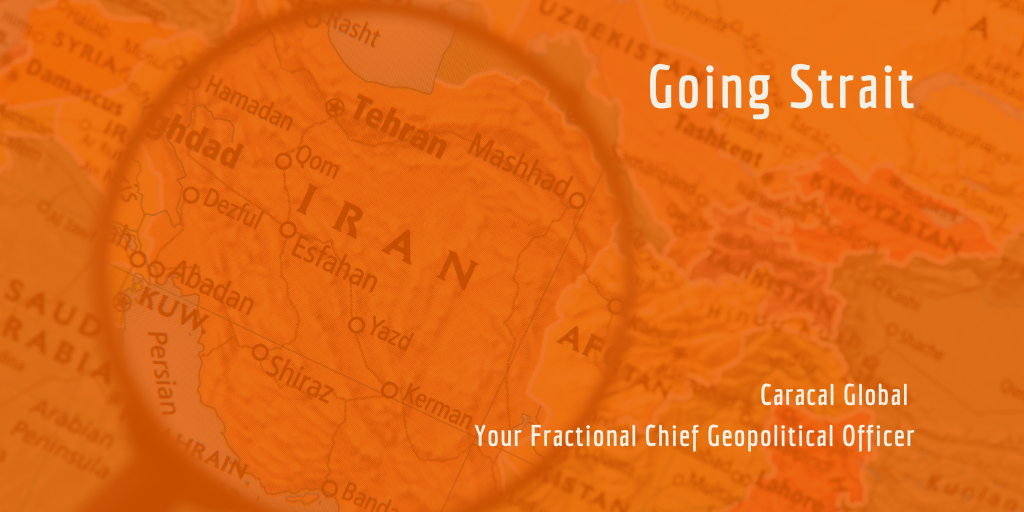
Going Strait

Three weeks ago, the Strait of Hormuz appeared in most corporate risk frameworks as a scenario — something flagged in annual reviews, noted in board presentations, and rarely acted upon. That era is over. Iran has demonstrated something that will outlast this conflict: closing the world's most critical shipping chokepoint is achievable, the United States cannot reopen it quickly or alone, and the economic consequences radiate far faster than any military response can contain them.

Drone strikes on Dubai's airport. Cyberattacks that knocked tens of thousands of Stryker employees offline. Satellite imagery of the Middle East is quietly disappearing from open-source intelligence feeds. Jet fuel prices are rising, and airlines are rerouting flights. An Emirates flight that departed Dublin, flew for ten hours, and turned back. This is not a regional conflict. It is a systemic stress test for the global economy — and most executive teams are still treating it like a headline rather than an operating reality.

The pattern this week is unmistakable. Trump bet that Iran would capitulate before closing the Strait. It didn't. US allies are declining the White House's call to send warships: Japan cites legal constraints, Britain says it won't be dragged into a wider war, Australia has declined, and Spain calls the conflict a threat to the global order. China — the country with the most genuine diplomatic leverage over Tehran — has no incentive to use it, particularly now that Trump is threatening to cancel the Xi summit as a pressure tactic. India is conducting quiet diplomacy and claiming results. Gulf states are recalculating their exposure. And Iran's drone and missile arsenal, cheap, plentiful, and battle-tested, is producing a conflict unlike anything the US military has faced in recent decades.

Three things your leadership team needs to act on now.

1. Energy cost assumptions for 2026 are wrong. Oil executives have already told the White House the fuel crunch will worsen. If your planning models reflect pre-war energy prices, rebuild them this week—Stress-test at $110, $120, and $130 per barrel. The Hormuz closure is not short-term noise. It has the structural characteristics of a prolonged disruption.

2. Semiconductor exposure is more immediate than most companies recognize. The war is threatening the helium and sulfur supplies that Taiwan's chipmaking sector depends on — and Taiwan Semiconductor alone accounts for roughly a fifth of Taiwan's economy. A sustained disruption cascades through consumer electronics, automotive, and industrial production, with limited lead time to respond. Procurement teams need contingency postures now, not in Q3 when the damage is already compounding.

3. Government affairs and corporate diplomacy are your most underutilized strategic assets in this environment. The countries navigating the crisis most effectively — India, Canada, the Nordics — are doing so through sustained diplomatic investment and active relationship capital. Your company needs the equivalent: direct access to decision-makers in the markets where you operate, intelligence on where policy is moving, and a communication strategy that positions your organization as a constructive actor rather than a reactive one.

Hormuz has demonstrated to every strategic adversary what is achievable at scale. The next disruption will come faster, from a different chokepoint, and with less warning.

This is precisely why Caracal Global exists. We specialize in global business issues at the intersection of globalization, disruption, and politics. We provide Fortune 1,000 companies and PE portfolio firms with fractional Chief Geopolitical Officer services — combining intelligence, strategy, and communications to help senior executives navigate today's interconnected business environment before a crisis becomes a cost. You need a CGO. You are not ready to hire one full-time. Caracal Global is your fractional solution.

Enjoy the ride + plan accordingly.

-Marc

*****

Marc A. Ross is a geopolitical strategist and the founder of Caracal Global, a fractional Chief Geopolitical Officer service for Fortune 1,000 companies and private equity firms. He publishes the Caracal Global Daily — what a Chief Geopolitical Officer monitors every morning. Subscribe at caracal.global/contact.