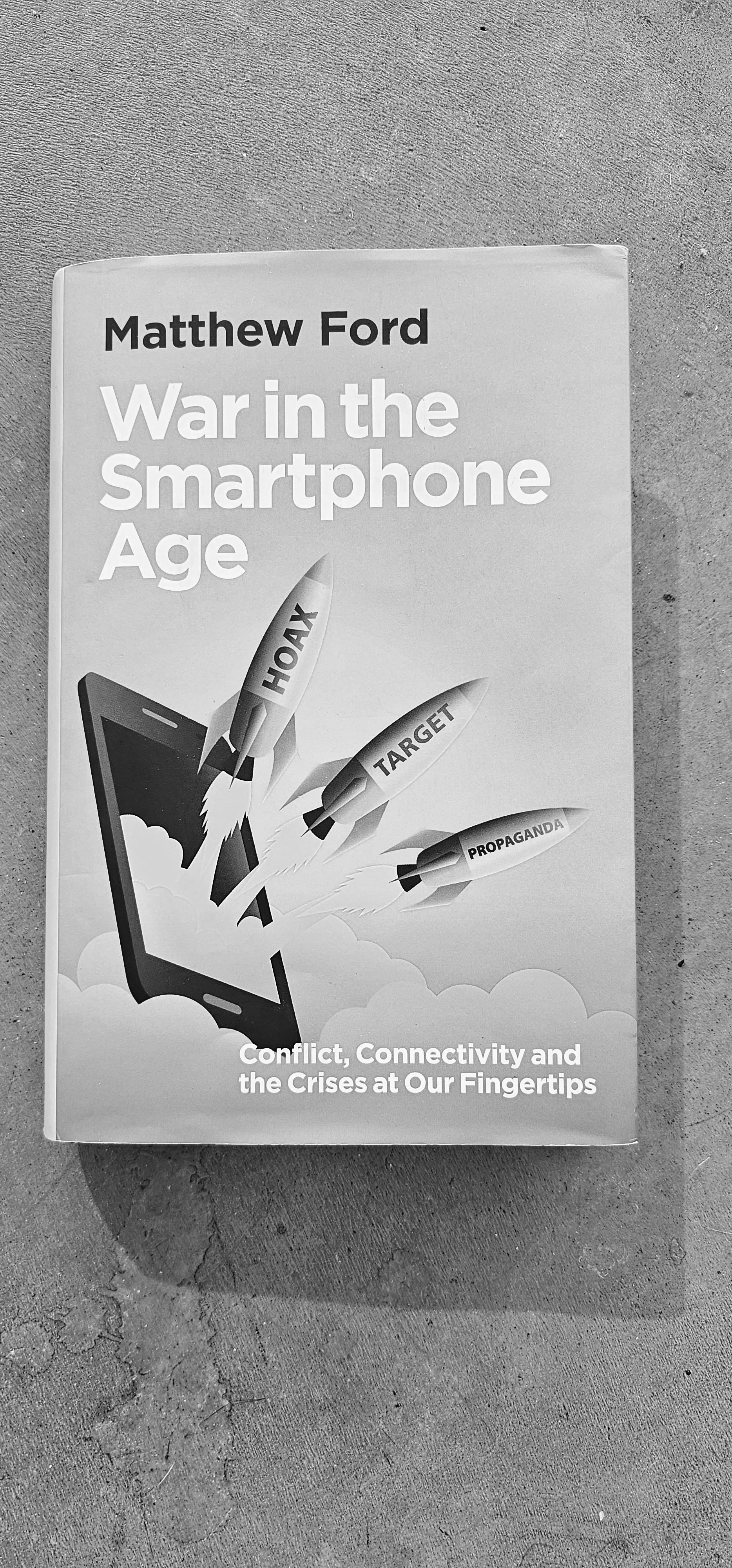
Get this on your reading list | War in the Smartphone Age: Conflict, Connectivity, and the Crises at Our Fingertips

Get this on your reading list…

War in the Smartphone Age: Conflict, Connectivity, and the Crises at Our Fingertips by Matthew Ford

This book helped me better appreciate how smartphones have forever changed warfare.

Three data points:

1.) The kill chain has collapsed: Smartphones have become key technology in the kill chain, compressing the time from identification to the striking of targets and sharpening the lethality of attacks. This started with JSOC in Anbar Province in 2005, but Ukraine normalized it at scale. The implication for drone equity analysis is that the software layer — targeting, data fusion, kill-chain integration — is where the durable margin lies, not the airframe.

2) Civilian sensors are now a military network: In March 2022 at Brovary, a network of civilian drones and smartphones helped Ukrainian forces locate, target, attack, and turn back an advancing column of Russian tanks and armored personnel carriers. The eVorog app turned civilian phones into an ISR network. Ford's point is that this architecture — civilian infrastructure merging with military targeting — is now the template.

3) Surveillance capacity has outrun human analysis: Surveillance drones that could once monitor ten directions simultaneously now record in over sixty-five directions at once, with Wide Area Motion Imagery enabling a single drone to watch over twenty-five square kilometers. The enormous volume of footage produced has overwhelmed military communications, processing, and storage systems, as well as available human resources. This is the AI integration story.

The bottom-line insight from Ford is that modern warfare is no longer defined by the platform (hardware) but by the network (software).

The smartphone has "democratized" lethality. Success in this new era belongs to whoever can most efficiently process information and close the kill chain through software, rather than whoever builds the most expensive hardware.

Enjoy the ride + plan accordingly.

-Marc.

You can always reach me @ marc@caracal.global.

*****

Marc A. Ross is a geopolitical strategist and the founder of Caracal Global, a fractional Chief Geopolitical Officer service for Fortune 1,000 companies and private equity firms. He publishes the Caracal Global Daily — what a Chief Geopolitical Officer monitors every morning. Subscribe at caracal.global/contact.
The world you planned for this year doesn't exist

Two months ago, global companies assumed three things: oil between $70 and $90, a stable transatlantic alliance, and a manageable cold war with China conducted primarily through tariffs.

This morning, all three assumptions are gone.

Oil is closing at levels not seen since the weeks after Russia invaded Ukraine. The US is in an active blockade of the Strait of Hormuz, with Iranian mines and drones halting commercial shipping. The Bank of England is publicly modeling a peak rate of 6.2%. Air France-KLM raised ticket prices. Air Canada pulled its 2026 outlook. Three American farmers told the Wall Street Journal they are switching corn acres to soybeans because diesel costs have rewritten the math on this growing season. None of this was in any board deck written before March.

Friedrich Merz, the German chancellor, said Washington had been humiliated by Tehran. Trump responded by floating troop withdrawal from Germany, a move the Pentagon said it was not expecting. The transatlantic alliance is now operating on the assumption that a personal spat can move 35,000 American service members. King Charles flew to Washington and used a state visit to deliver, in the British press's reading, a master class in understated rebuke. He also extracted the elimination of Scotch whisky tariffs on the same trip. That is the new statecraft: monarch-as-trade-negotiator.

The UAE has left OPEC. Read that sentence twice. The architecture of the global oil cartel that has shaped energy markets since 1960 just lost one of its most important members, and Abu Dhabi is now openly aligning with Israel against Iran while Saudi Arabia watches. The Wall Street Journal called it a new Middle East order. That is not hyperbole. It is the most accurate description.

In Washington, Senator Susan Collins (R-ME) flipped her vote on the Iran war. House Speaker Mike Johnson (R-LA) is insisting the US is not at war as the 60-day War Powers clock runs out. DefSec Pete Hegseth is telling the Senate that the ceasefire has paused the deadline. Press conferences and tweets are rewriting the legal framework governing American military deployments since 1973. Meanwhile, the Supreme Court's voting rights ruling has triggered a redistricting arms race. Louisiana has already suspended a primary. Florida is next. The political map your government affairs team modeled in January is obsolete.

And beneath it all, AI capex is on track to reach $1 trillion by 2027. The hyperscalers are spending faster than their cash flow can sustain. Intel's share price doubled in April. Apple printed $111 billion in Q1. Mark Zuckerberg blamed the war in Iran for Meta's slower sales and for AI costs that led to layoffs. The AI supply crunch is now a board-level resource allocation problem, not a technology problem.

Here is what this means for your company.

The post-Cold War assumption that economic interdependence prevents conflict has been reversed. Conflict - military and trade - is now reshaping economic interdependence in real time, and your board has been operating on a model that no longer applies. You cannot navigate this environment with a quarterly review cadence and an annual offsite. You need continuous geopolitical intelligence, weekly scenario planning, and a communications posture that anticipates volatility rather than reacts to it.

That is what a Chief Geopolitical Officer does. Caracal Global provides this capability on a fractional basis to Fortune 1,000 companies and private equity portfolios that need the function but are not ready to hire it full-time. If the items above are now on your board's agenda and you do not have a geopolitical officer in the room, that is the conversation we should be having this week.

Enjoy the ride + plan accordingly.

-Marc.

You can always reach me @ marc@caracal.global.

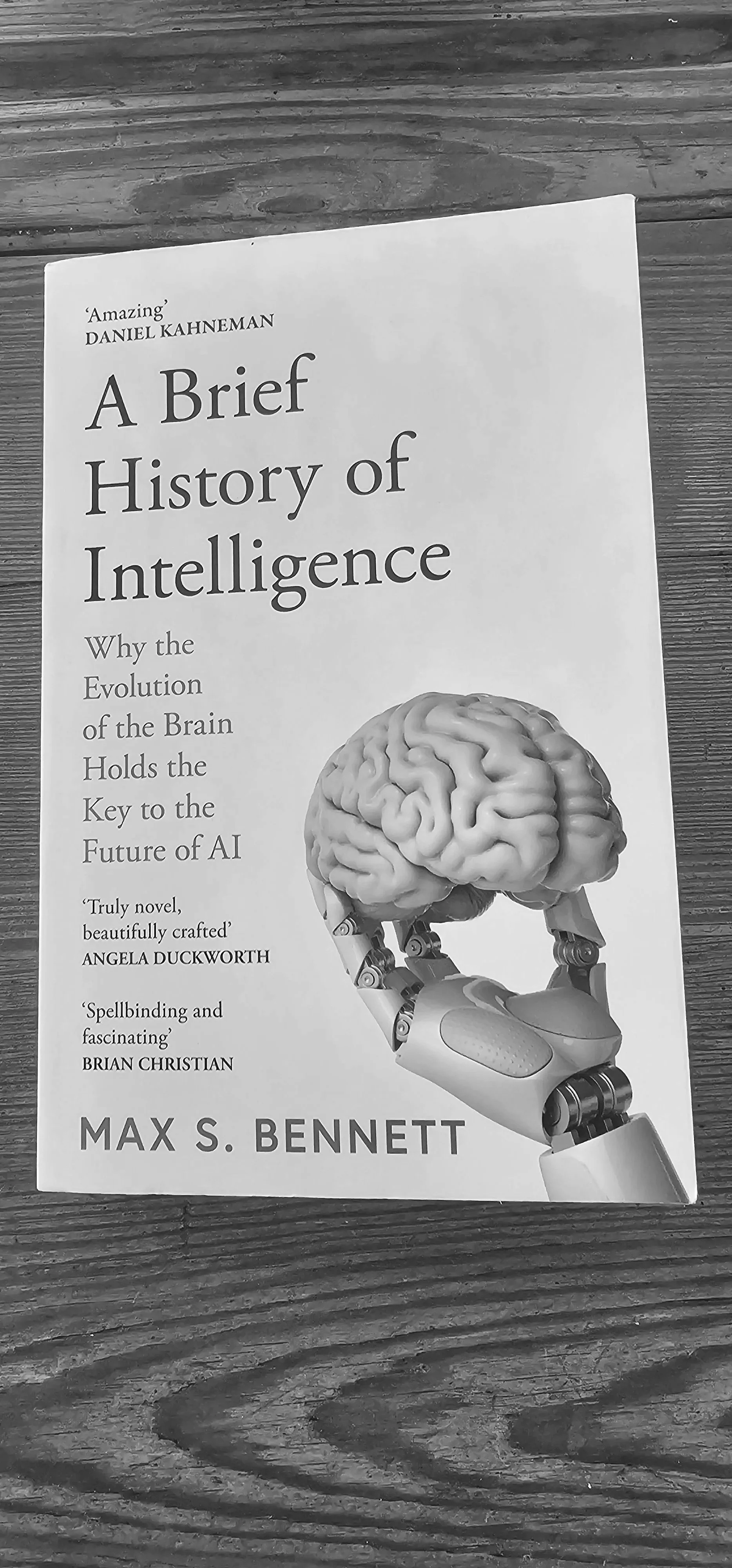
Get this on your reading list | A Brief History of Intelligence

Get this on your reading list…

A Brief History of Intelligence: Evolution, AI, and the Five Breakthroughs That Made Our Brains by Max Bennett

This book helped me immensely with my understanding of human and artificial intelligence.

Three data points:

1) The simulation gap explains why AI can beat a chess grandmaster, but it can't load a dishwasher: A human brain has a neocortex, which allows it to simulate possible outcomes of actions before taking them. Think planning, recalling past events, and more efficient learning by imagination. Bennett argues that current AI systems lack this.

2) Reinforcement learning is 500 million years old; AI just rediscovered it: Human life acquired the capability to learn to repeat behaviors that lead to good or bad outcomes. AI reinforcement learning is just beginning, but the brain does it with far less data and energy; a human is far more energy-efficient.

3) AI can't read the room: Humans have developed the ability to track what other individuals know, want, and intend. Humans understand context and have high EQ. Current AI lacks this ability.

Bennett concludes that AI systems' evolution won't be constrained by biology the way ours was, so that the next breakthrough could compress millions of years of evolutionary time into years of engineering.

Enjoy the ride + plan accordingly.

-Marc.

You can always reach me @ marc@caracal.global.

*****

Marc A. Ross is a geopolitical strategist and the founder of Caracal Global, a fractional Chief Geopolitical Officer service for Fortune 1,000 companies and private equity firms. He publishes the Caracal Global Daily — what a Chief Geopolitical Officer monitors every morning. Subscribe at caracal.global/contact.