When American allies stop trusting and a post-predictability era

Canadian Prime Minister Mark Carney's Davos warning was blunt: we are entering a new world order "in the midst of a rupture." For multinational executives, this isn't abstract geopolitics—it's a planning crisis. How do you allocate capital, structure supply chains, and enter markets when the post-WWII framework that made cross-border commerce predictable is fracturing in real time?

Trump's rambling Davos address and his public dismissal of Carney crystalized the problem: mid-tier nations—Japan, Germany, Canada, South Korea, Australia, and others—are being forced to choose sides between the US and China. These aren't ideological choices. They're commercial decisions that will reshape trade flows, technology standards, and regulatory environments for a generation.

Trump's Davos performance reminded me of the Midwest business leaders I grew up around—the type who return from London with a Burberry scarf from Harrods and a conviction they know how to run the planet. The rhetoric is familiar: "You'd be speaking German without us," and "Canada wouldn't exist without us."

These statements might be historically defensible, but they reveal a psychological pattern that matters for business planning: American oscillation between global engagement and continental withdrawal.

Robert Kagan—Brookings senior fellow and former State Department official—has spent decades analyzing this pattern. In his 2021 Foreign Affairs essay and his book The World America Made, Kagan identifies what he calls America's core strategic problem: "Their capacity for global power exceeds their perception of their proper place and role in the world."

Unlike China (seeking to recover past greatness) or Russia (nostalgic for superpower status), Americans have never internalized their global role as permanent. Even after defeating Nazism, Soviet communism, and radical Islamist terrorism, most Americans view international engagement as exceptional rather than normal.

The result, Kagan writes, is "a century of wild oscillations—indifference followed by panic, mobilization and intervention followed by retreat and retrenchment."

For executives navigating transatlantic and transpacific strategy, this oscillation is the risk variable. It's why calling Afghanistan and Iraq "forever wars" matters—it signals American intolerance for the "messy, unending business of preserving a general peace."

Kagan argues that this on-again, off-again approach "has confused and misled allies and adversaries alike, often sparking conflicts that a steady application of American power and influence in service of a peaceful, stable, liberal world order could have avoided."

For business leaders, the question isn't whether America should be a reliable hegemon—it's whether America will be predictable enough to build long-term strategies around.

Carney's speech suggests allied governments are no longer confident in the answer. When Canada's prime minister urges mid-tier nations to "band together" and Trump refuses to meet with him, that's not diplomatic theater—it's a signal that traditional alliance frameworks are no longer reliable guardrails for commercial planning.

Companies with significant cross-border exposure face three immediate planning challenges:

1. Alliance reliability as a supply chain variable: If US security commitments become transactional or unpredictable, allied nations will diversify away from US-dependent systems. This affects everything from semiconductor supply chains to defense procurement to technology standards. Scenario plan for reduced US-allied coordination.

2. The mid-tier nation dilemma: When countries like South Korea, Australia, or Germany are forced to choose between US and Chinese economic orbits, they won't choose ideology—they'll choose commercial pragmatism. Map your exposure to markets facing this binary choice and develop strategies for both scenarios.

3. Institutional breakdown risk: Kagan warns that declining US leadership leads to "global instability, renewed great-power conflict, and the breakdown of vital international institutions." For multinationals, this means the WTO, international arbitration systems, and multilateral agreements may lose enforcement power. Build redundancy into governance frameworks.

The Kagan framework suggests this isn't a Trump phenomenon—it's an American psychology that predates and will outlast any single administration. That has planning implications:

+ Stop planning for policy clarity; plan for policy volatility. Build flexibility into capital allocation decisions that assume US oscillation between engagement and withdrawal.

+ Develop direct government engagement channels in key allied markets that don't depend on Washington coordination. If Carney is urging mid-tier nations to band together, your government affairs strategy should reflect that emerging architecture.

+ Treat US power as a declining variable, not a constant. Kagan argues the post-WWII order "depends on US power, not just American ideals." If that power becomes unreliable or internally focused, the order changes. Stress-test your strategies against scenarios where US economic and security commitments are transactional rather than foundational.

As for the recovery question, can America recover from what I view as a self-inflicted wound?

I believe yes, but Kagan's point is that American psychology makes sustained global leadership unnatural for most US citizens. The twentieth century, he notes, "was littered with the carcasses of foreign leaders and governments that misjudged the United States."

For executives, the lesson isn't to bet against American power—it's to stop assuming American consistency.

The unprecedented peace and prosperity of the post-WWII era represents a unique achievement in human history. But as Carney warned, we're now in the rupture. Your planning frameworks need to reflect that new reality.

Bottom line: Build strategies that can succeed whether America remains globally engaged or retreats into continental psychology. The oscillation itself is the constant.

-Marc

*****

Marc A. Ross is a geopolitical strategist and communications advisor. He is the founder of Caracal Global and is writing a book entitled Globalization and American Politics: How International Economics Redefined American Foreign Policy and Domestic Politics.
Trump's Davos speech: A wake-up call for European business leaders

European civic and business leaders at Davos got to see the real deal this week: an unfiltered Donald Trump—not just clips, highlights, and soundbites, but a full rambling, incoherent, zigzagging speech, live and in-person.

This isn't going to make them feel better about the state of the world.

Rory Stewart, a British academic, broadcaster, writer, and former diplomat and politician, tweeted: "One of the things I had not appreciated until I was in the room was how a flurry of misleading—and often fake statistics—embedded with a direct mafia demand for Greenland/'Iceland'—can simultaneously brutalize the world order while also being repetitive, flat and boring."

For European executives navigating transatlantic business strategy, this is a critical moment.

The dissonance between Trump's Davos messaging and the policy predictability that European boardrooms need creates a strategic challenge: How do you plan capital allocation, supply chain decisions, and market-entry strategies when the signals from Washington are this erratic?

The gap between Trump's presentation style and the structured, policy-coherent communication that European leaders expect from US administrations is more than political theater—it's a business risk factor.

Companies with significant US-Europe exposure need to scenario-plan for policy volatility, not policy clarity.

Bottom line: The Davos appearance confirmed what many European C-suites already suspected—managing US political risk requires real-time monitoring, flexible strategy frameworks, and direct stakeholder engagement channels that bypass official rhetoric.

This is the new normal for transatlantic business relations.

-Marc

****

Marc A. Ross is a geopolitical strategist and communications advisor. He is the founder of Caracal Global and is writing a book entitled Globalization and American Politics: How International Economics Redefined American Foreign Policy and Domestic Politics.
Navigating the new corporate-Trump dynamic: A geopolitical business perspective

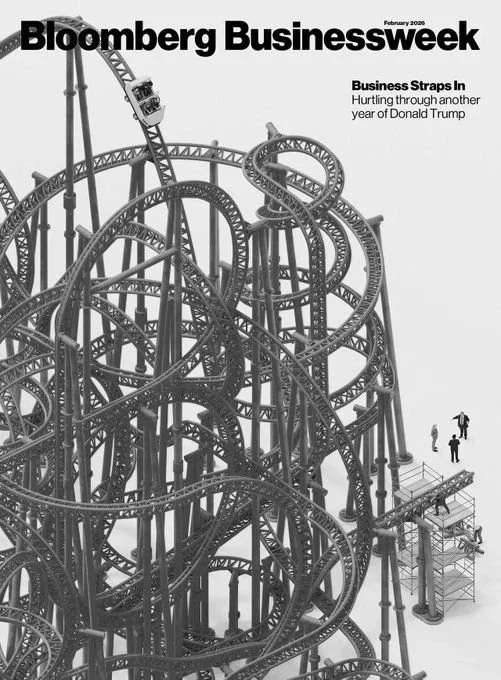
Looking at Bloomberg's stark cover image, a chaotic roller coaster representing the business's wild ride through another Trump presidency, this is a fundamental shift in how executives approach corporate-government relations. 

This isn't business as usual. We're witnessing what historian Jonathan Levy of Sciences Po in Paris calls "unprecedented personalization of government and business dealings."

What I'm seeing on the ground

From my vantage point, advising Fortune 1000 companies and emerging tech leaders, I observe executives constantly recalibrating their strategies in real-time. The traditional playbook—the one that assumed institutional norms, policy predictability, and arms-length government-business relations—no longer applies. Trump has introduced what I call "patrimonial state capitalism," where loyalty to persona supersedes loyalty to laws and institutions.

Consider these moves in recent days: A proposed 10% cap on credit card interest rates that stunned Wall Street, pressure on energy companies to rebuild Venezuela's decrepit oil infrastructure, and a criminal investigation into the Fed Chair. These aren't isolated incidents. They represent a systematic rewriting of the rules of engagement between the Oval Office and corporate America.

The strategic framework I'm recommending

Drawing on my experience in presidential campaigns, energy regulatory environments, and emerging technology policy, I'm advising clients to adopt a multi-touch, expand the echo chamber communications strategy.

1. Strategic access isn't optional; it's essential: I'm helping clients build what Bloomberg calls "back channels," but I frame it differently: strategic stakeholder mapping. Access to Trump remains concentrated, but pathways exist through Chief of Staff Susie Wiles, Treasury Secretary Scott Bessent, and Commerce Secretary Howard Lutnick, both finance veterans who understand business language.

2. Education over confrontation: Bloomberg explored how Target CEO Brian Cornell's approach to dealing with the White House exemplifies what I advocate: lead with data, frame around presidential priorities, and use visual communication. Trump famously doesn't read briefing books, but he prides himself on his business instincts. I'm coaching executives to distill complex geopolitical and economic issues into compelling, visually supported narratives that align with Trump's stated goals: job creation, American manufacturing, and Main Street economics.

3. The medium shapes the message: Bloomberg wrote how Coca-Cola's James Quincey and Eli Lilly's Dave Ricks both chose Fox Business to announce major initiatives. This isn't coincidental, it's smart. I'm advising clients on media strategy optimization in an environment where conservative influencers and X form a coordinated amplification machine for administration messaging. Companies must understand that traditional media relations strategies don't capture the attention of this administration. I'm helping clients develop dual-track communication approaches, one for conventional stakeholders, another optimized for the MAGA media ecosystem.

4. Everything is indeed a transaction—but understand the currency: Bloomberg quotes BGR consultant David Urban, who cites a Beltway adage: “The first rule of horse trading is to have a horse.” This adage resonates with my experience in government relations. But here's what I'm seeing that goes beyond Bloomberg's analysis: the currency isn't just financial, it's political capital, media narrative, and symbolic gestures. Intel's handling of US government intervention, sponsorships of America's 250th anniversary celebration, and donations to the $400 million White House ballroom project represent strategic positioning investments. I'm helping clients evaluate which commitments provide genuine protection versus which create dependency without corresponding benefits.

The geopolitical business reality I'm tracking

Bloomberg's article focuses on domestic corporate strategy, but I'm advising clients on the international implications. Trump's interventionist approach doesn't stop at the US border; it reshapes global capital flows and supply chains, causes headaches in the capitols of allies and enemies alike, and alters the balance of power between business, regulators, and governments worldwide.

Critical observations from my work:

+ US-China commercial relations are being restructured through personalized diplomacy rather than institutional frameworks

+ Technology policy increasingly depends on individual corporate relationships with the administration rather than sectoral regulation

+ Trade policy has become a tool of political leverage rather than economic optimization

What I'm telling my clients right now

As I prepare executive briefings and intelligence memos, I emphasize five realities:

1. Scenario planning is your primary defense: I'm helping clients map out multiple futures—not just optimistic and pessimistic scenarios, but discontinuous possibilities. What happens if Trump's approval continues falling? How do midterm election outcomes shift the dynamic? What if monetary policy independence collapses? What if allies sell US bonds?

2. Communication strategy must be dynamic, not static: My "Always Be Communicating" philosophy takes on new urgency. Companies can't wait for crises to develop communication plans. I'm working with clients to establish real-time response protocols that allow rapid pivots as circumstances shift.

3. Your stakeholder map just got more complex: Traditional corporate advocacy through the Business Roundtable and Chamber of Commerce remains essential, but insufficient. I'm helping clients identify emerging power centers and build high-low relationships before they're needed.

4. Brand reputation + political positioning are now inseparable: The risk isn't just to share price—it's to corporate reputation with employees, customers, and investors who may have very different political orientations than the administration. I'm advising clients on triangulation strategies that maintain government relationships without alienating other critical stakeholders.

5. This isn't temporary—prepare for massive structural change: Whether Team Trump wins reelection or not, this personalized, interventionist approach to business-government relations has demonstrated its viability. I'm helping clients build capabilities and strategies that work in this environment while remaining adaptable to potential shifts.

The bottom line for global investors + executives

Bloomberg's assessment is accurate: We're dealing with the most interventionist US president in almost a century. But here's what I add from my geopolitical strategy perspective: this moment represents a fundamental test of corporate political intelligence and holistic communications.

The companies that thrive in this new paradigm won't be those with the best legal arguments or the most principled positions. They'll be organizations that combine strategic access, sophisticated communication, scenario planning, and genuine flexibility. They'll understand that in this new environment, relationships matter more than regulations, narratives matter more than norms, and adaptability matters more than ideology.

As Bloomberg notes, "A playbook only works when there are clear rules for the game, but Trump can change them at any time." 

We're not on a predictable track. We're on that chaotic roller coaster Bloomberg depicted. But with the proper strategic framework, communication approach, and geopolitical awareness, companies can navigate this environment not just defensively, but in ways that position them for whatever comes next.

-Marc